
Filter
689
Text search:
evacuation
Featured
65
208
Language
Document type
445
69
63
51
21
14
12
11
Countries
35
20
17
17
16
15
14
14
12
11
11
10
10
10
9
8
8
7
7
6
6
6
6
6
5
5
5
4
4
4
4
3
3
3
3
3
3
3
3
3
3
3
3
3
3
3
2
2
2
2
2
2
2
2
2
2
2
2
2
1
1
1
1
1
1
1
1
1
1
1
1
1
1
1
1
1
1
1
1
1
1
1
1
1
1
1
1
1
1
Authors & Publishers
Publication Years
Category
197
46
45
43
21
14
5
3
2
Toolboxes
75
72
53
48
36
34
27
27
21
16
15
8
7
5
3
2
2
2
1
1
1
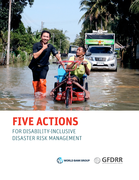
A recent survey of the literature and experience identified five broad actions that development institutions and governments, as well as their partners and stakeholders, can take to improve disability-inclusive disaster risk management. Those five actions are:
- Include persons with disabilitie ...
- Include persons with disabilitie ...

This paper provides information to assist World Bank and GFDRR staff in affecting disability-inclusive DRM. It is based upon desk reviews of existing practice, as well as consultations with experts in the field of disability-inclusive DRM. The paper:
- Illustrates promising practices related to ...
- Illustrates promising practices related to ...
This Manual is primarily intended for community level volunteers trained in Community Based Disaster Risk Management (CBDRM) and CBDRM Practitioners and Professionals.
The year of publication is not specified in the document.
The year of publication is not specified in the document.
The purpose of this ‘Facilitator Guidebook’ is to help the Course Coordinator deliver and document consistently high-quality CBDRR training courses.
- Module 1: Understanding the Basics: introduces the participants to the basics of CBDRR implementation of MRCS, general aspects of CBDRR in ...
- Module 1: Understanding the Basics: introduces the participants to the basics of CBDRR implementation of MRCS, general aspects of CBDRR in ...
The CBDRR Step-by-Step Methodology aims to guide the effective implementation of new community-based as well as school-based interventions implemented by MRCS as well as other DRR actors in Myanmar identifying key steps that need to be followed under each program as well as minimum activities for ea
...

This handbook presents basic content and tips for implementing a school-based risk reduction programme. It is organised into five modules: its importance; approach and process; activities to benefit children up to five years old; activities for students aged 5–17; and activities for young people a
...
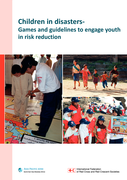
This guideline consists of two main parts:
i.) Guidelines for Red Cross and Red Crescent national societies on how to start up and engage with other stakeholders in country in rolling out disaster risk reduction (DRR) education and awareness activities for children - not only in school, but also ...
i.) Guidelines for Red Cross and Red Crescent national societies on how to start up and engage with other stakeholders in country in rolling out disaster risk reduction (DRR) education and awareness activities for children - not only in school, but also ...
No publication year indicated
In the context of the floods in August 2015 in Myanmar, the Disaster Risk Reduction Working Group (DRR WG) was requested to provide clear recommendations to the DMH (Department of Hydrology and Meteorology)to strengthen preparedness activities, in particular for t ...
In the context of the floods in August 2015 in Myanmar, the Disaster Risk Reduction Working Group (DRR WG) was requested to provide clear recommendations to the DMH (Department of Hydrology and Meteorology)to strengthen preparedness activities, in particular for t ...

Asia-Pacific Disaster Report 2017
The report looks at the extent and impact of natural disasters across the region and how these intersect with poverty, inequality and the effects of violent conflict. But it also shows how scientific and other advances have increased the potential for building di ...
The report looks at the extent and impact of natural disasters across the region and how these intersect with poverty, inequality and the effects of violent conflict. But it also shows how scientific and other advances have increased the potential for building di ...
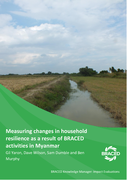
The BRACED Myanmar Alliance was a three-year project aiming to ‘build the resilience of 350,000 people across Myanmar to climate extremes’. The project worked in 7 states, 8 townships and 155 communities. The main impact for project populations was intended to be ‘improved well-being and reduc
...
This is the Technical Annex for the BRACED report: Measuring changes in household resilience as a result of BRACED activities in Myanmar.

The guidance aspires
• To emphasize the 'need' to mainstream disaster risk reduction (DRR) in the health sector initiatives.
• To identify key approaches for mainstreaming DRR in the health sector in Myanmar, particularly in rural areas, based on the good practices, innovative approach ...
• To emphasize the 'need' to mainstream disaster risk reduction (DRR) in the health sector initiatives.
• To identify key approaches for mainstreaming DRR in the health sector in Myanmar, particularly in rural areas, based on the good practices, innovative approach ...

Lack of satisfactory progress in mainstreaming disaster risk reduction within development is attributed to various factors. One of the important factor that is often not much appreciated is the inadequate comprehension of mainstreaming and the absence of clear, cogent and practical guidelines, tools
...
The scope of the Guidance is primarily the education in rural settings in Myanmar, but it covers some of the issues which have pan Myanmar implication and relevance. Considering the importance, complexity and vastness of the subject, similar type of initiatives on urban school and education system a
...
The Strategic Framework for Emergency Preparedness is a unifying framework which identifies the principles and elements of effective country health emergency preparedness. It adopts the major lessons of previous initiatives and lays out the planning and implementation process by which countries can
...

Draft for consultation

The Indonesian government has reformed its laws, policies, and institutions to better manage disaster risk since the significant 2004 Indian Ocean Tsunami. The Government of Indonesia now has contingency plans for every disaster-prone city which identifies its vulnerabilities, outlines the relief re
...
