
Filter
514
Text search:
R.
Campbell
Featured
Recommendations
37
New Publications
64
Language
Document type
No document type
243
Studies & Reports
142
Guidelines
60
Manuals
26
Strategic & Response Plan
14
Training Material
12
Fact sheets
11
Situation Updates
5
Infographics
1
Countries / Regions
Global
26
Russia
12
Kenya
10
Tanzania
9
Zimbabwe
8
Uganda
7
India
7
South Africa
7
Latin America and the Carribbean
7
Western and Central Europe
7
Africa
7
Ethiopia
6
Nepal
6
Indonesia
6
Eastern Europe
6
Liberia
5
Ukraine
5
Rwanda
4
Colombia
4
West and Central Africa
4
Venezuela
4
Sierra Leone
3
Ghana
3
Germany
3
Zambia
3
Cambodia
3
Bangladesh
3
Mozambique
3
Brazil
3
Kyrgyzstan
3
USA
2
Philippines
2
Syria
2
Malawi
2
Namibia
2
Lesotho
2
Yemen
2
East and Southern Africa
2
South–East Asia Region
2
Western Pacific Region
2
Paraguay
2
Asia
2
Tajikistan
2
United Kingdom
2
Spain
2
Bosnia and Herzegovina
2
Burkina Faso
1
Nigeria
1
Senegal
1
Mali
1
Guinea-Bissau
1
Haiti
1
Pakistan
1
Thailand
1
Singapore
1
Sudan
1
Benin
1
Peru
1
Ecuador
1
Botswana
1
Angola
1
Mexico
1
Myanmar / Burma
1
Sri Lanka
1
Chile
1
Middle East and North Africa
1
Southern Africa
1
Canada
1
Moldova
1
Kazakhstan
1
Turkmenistan
1
Portugal
1
Israel
1
Authors & Publishers
Publication Years
Category
Countries
135
Clinical Guidelines
45
Public Health
38
Women & Child Health
30
Key Resources
15
Capacity Building
3
Pharmacy & Technologies
2
Toolboxes
Planetary Health
71
Mental Health
64
HIV
34
COVID-19
34
Disability
33
Global Health Education
25
NCDs
25
Caregiver
22
TB
20
NTDs
15
Ebola
9
Rapid Response
7
AMR
6
Natural Hazards
4
Health Financing Toolbox
4
Conflict
3
Refugee
3
Social Ethics
3
Polio
2
Pharmacy
2
The emergence and transmission of zoonotic diseases are driven by complex interactions
between health, environmental, and socio-political systems. Human movement is considered
a significant and increasing factor in these processes, yet forced migration remains an
understudied area of zoonotic res
...
Lancet Planet Health 2021; 5: e542–52
There is little doubt that 2019 was a defining year on many fronts for the environment. The repercussions of the climate emergency were experienced across the globe, with floods, devastating wildfires, and unprecedented melting of polar ice sheets and glaciers. While the new decade began with the Au
...
In 2015, 5.9 million children under age five died (1). The major causes of child deaths globally are pneumonia, prematurity, intrapartum-related complications, neonatal sepsis, congenital anomalies, diarrhoea, injuries and malaria (2). Most of these diseases and conditions are at least partially cau
...
En 2015, murieron 5,9 millones de niños menores de cinco años (1). Las principales causas de muerte en los niños a nivel mundial son la neumonía, la prematuridad, las complicaciones durante el parto, la sepsis neonatal, las anomalías congénitas, las enfermedades diarreicas, las lesiones
...
Known avoidable environmental risks to health cause at least 12.6 million deaths every year, and account for about one quarter of the global burden of disease (2016 data) (1). Air pollution alone causes about 7 million
deaths a year, placing it among the top global risks to health (2). Global envir
...
The arrival and rapid spread of the mosquito-borne viral disease Chikungunya across the Americas is one of the most significant public health developments of recent years, preceding and mirroring the subsequent spread of Zika. Globalization in trade and travel can lead to the importation of these vi
...
This article provides an overview of the current and projected climate change risks and impacts to mental health and provides recommendations for priority actions to address the mental health consequences of climate change.
The Lancet Published Online September 13, 2016 http://dx.doi.org/10.1016/S0140-6736(16)31404-0
2016 ASCO EDUCATIONAL BOOK | asco.org/edbo
One Earth Perspective. Cell Press
Journal of Land Use Science, 16:3, 223-239, DOI: 10.1080/1747423X.2021.1933226
Briefing Note no. 80 November 2015

The Lab identifies, develops, and launches sustainable finance
instruments that can drive billions to a low-carbon economy. The
2019 Global Lab Cycle targets four specific sectors across
mitigation and adaptation: blue carbon in marine & coastal
ecosystems; sustainable agriculture for smallholde
...
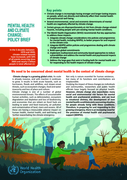
We need to be concerned about mental health in the context of climate change
