
Filter
782
Text search:
World
Health
Organization
(WHO),
Regional
Office
for
the
Western
Pacific
Featured
99
190
Language
Document type
354
177
138
50
28
11
8
8
4
3
1
Countries / Regions
62
28
25
20
16
14
14
13
12
10
9
7
7
7
6
6
5
5
5
4
4
4
4
4
3
3
3
3
3
3
3
3
2
2
2
2
2
2
2
2
2
2
1
1
1
1
1
1
1
1
1
1
1
1
1
1
1
1
1
1
1
1
1
1
1
Authors & Publishers
Publication Years
Category
131
107
63
50
30
19
11
1
1
Toolboxes
80
72
66
55
47
40
33
29
27
26
26
23
18
14
13
12
11
9
6
6
3
3
2
Global concerns: Implications for the future
Child Mental Health Atlas
The Atlas of health and climate is a product of this unique collaboration between the meteorological and public
...
The global burden of disease associated with air pollution exposure exacts a massive toll on human health worldwide: exposure to air pollution is estimated to cause millions of deaths and lost years
...
Recommendations for a public health approach
HIV/AIDS Programme
Cholera is a major health risk in many parts of the world, affecting millions of people every year. Since mid-2021,
...
Emergencies, in spite of their tragic nature and adverse effects on mental health, are unparalleled opportunities to build better mental health systems fo
...
The WHO continuously reviews available data on SARS-CoV-2 variants of concern. For this version, the
...
Known avoidable environmental risks to health cause at least 12.6 million deaths every year, and account for about one quarter of the global burden
...
Taking a multisectoral, One Health approach is necessary to address complex health threats at the human-animal-environment interface, such as rabie
...
WHO/HTM/TB/2007.384a
“TB is too often a death sentence for people with AIDS.
It does not have to be this way.”
-Nelson Mandela, International conference on HIV /AIDS, Bangkok, Thailand, Jul
...
Reduce Risk, Protect Health Facilities, Save Lives
Practical Guidance for collaborative interventions
Guidelines for essential trauma care. Russian Version
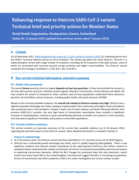
21 January 2022
The overall threat posed by Omicron largely depends on four key questions: (i) how transmissible the variant is; (ii) how well vaccines and prior infection protect against infection
...
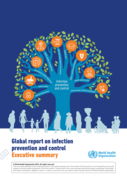
The report reveals that good IPC programmes can reduce health care infections by 70 %. oday, out of every 100 patients in acute-care hospitals, seven patients in high-income countries and 15 patient
...
Outstanding child and adolescent TB priorities include the need to: find the missing children with active TB and link them to TB care; prevent TB in children
...
Manual for Early Implementation
This document provides guidance on how to implement contact screening and chemoprophylaxis with single-dose rifampicin. The contents are logically ordered: counselling and obtaining consent, identification and listing of index case, listing of conta
...
Fact Book on WHO Level I and Level II monitoring indicators - To monitor the progress of efforts to improve the global medicines situation,
...
Out of the shadows
