
Filter
58
Text search:
non-camp
settings
Featured
15
15
Language
Document type
21
15
12
5
3
2
Countries / Regions
7
6
5
3
2
2
2
2
1
1
1
1
1
1
1
1
1
1
1
1
1
1
1
1
1
1
1
1
Authors & Publishers
Publication Years
Category
18
3
2
1
Toolboxes
21
10
6
5
3
1
1
1
UNHCR’s Public Health Strategy 2021-2025 is based on the lessons learnt, and builds on the achievements, of the Global Strategy for Public Health 2014-2018.
Progress was made on policies favouring inclusion and integration into national systems3 with 92% of 48 operations surveyed reporting refuge
...
This document summarizes current WHO guidance for public health surveillance of coronavirus disease 2019 (COVID-19) in humans caused by infection with severe acute respiratory syndrome coronavirus 2 (SARS-CoV-2).
New elements include:
update of contact definitions, in line with latest cont
...
The United Nations Network on Migration is committed to supporting all partners in pursuit of the implementation of the Global Compact for Safe, Orderly and Regular Migration, recognizing that this cooperative framework provides an invaluable tool for ensuring inclusive, collective responses to COVI
...
Guidance | Preparedness - Response and early recovery - Recovery and reconstruction
The Lancet Published Online September 13, 2016 http://dx.doi.org/10.1016/S0140-6736(16)31404-0
Le présent document accompagne le document d’orientation provisoire Renforcer la préparation à l’épidémie de COVID-19 dans les villes et autres milieux urbains, qui vient compléter le plan stratégique de préparation et de riposte et la mise à jour de la stratégie
22.9% of surveyed Syrian refugees aged 2 years and above had disabilities (1,374 persons out of 6,003 persons): 13.8% in Azraq camp, 23.5% in Irbid and 30.5% in Zaatari camp. Understanding disability as the level of difficulties a person is facing when performing basic activities that could put him/
...
English Analysis on World about Disaster Management and Protection and Human Rights; published on 12 Jan 2021 by IFRC

March - December 2018
The Government of Bangladesh has kept its borders open to Rohingya refugees and leads the humanitarian response. The people of Bangladesh continue to show tremendous generosity and hospitality in the face of a massive influx. In keeping with its policies, the Government of Ban
...
В этом документе изложена стратегия
Европейского региона ВОЗ в области
реагирования на COVID-19 и ликвидации
его последствий на основе актуальной
глобальной стратÐ
...
This strategic document is relevant to the diverse contexts that exist across the WHO European Region, and to countries implementing a wide range of national and subnational responses. The strategy is flexible and adaptable to national and subnational contexts and guides countries in rapidly bringin
...
The Gap Report 2014
These country reports provide information on the legal situation for displaced populations, namely asylum seekers, refugees, and returnees, where relevant, regarding access to mobile services, in each country covered
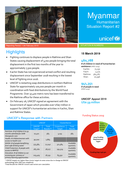
Fighting continues to displace people in Rakhine and Shan States causing displacement of 3,700 people bringing the total displacement in the first two months of the year to approximately 7,500 people.
UNICEF is restarting soap distributions in northern Rakhine State for approximately 100,000 peo
...
The COVID-19 pandemic poses an additional and critical challenge in a fragile humanitarian context, where the population is already highly vulnerable and lives in often overcrowded settlements where distancing is impossible, and with limited access to basic health services and hygiene. Further sprea
...
