
Filter
1510
Text search:
efficacy
of
medicines
Featured
185
434
Language
Document type
786
293
218
81
59
30
18
10
6
4
3
1
1
Countries
70
60
49
42
38
36
31
28
28
26
25
25
24
22
21
20
19
17
16
16
13
12
11
11
11
10
10
10
9
9
8
8
8
7
7
7
7
6
6
6
6
5
5
5
4
4
4
3
3
3
3
3
3
3
3
2
2
2
2
2
2
2
2
2
2
2
2
2
2
2
2
2
1
1
1
1
1
1
1
1
1
1
1
1
1
1
1
1
1
1
1
1
1
1
1
1
Authors & Publishers
Publication Years
Category
576
206
105
65
24
24
20
Toolboxes
130
129
116
113
107
85
48
41
26
24
21
19
16
15
8
8
6
5
5
4
2
1

The Adult Standard Treatment Guidelines and Essential Medicines List for Hospital Level provide a platform for transparency to enable equitable access to safe, effective, and affordable treatment options at hospital level taking into consideration t
...

GOVERNMENT NOTICE | No. 192 Promulgation of Medicines and Related Substances Control Act, 2003 (Act No. 13 of 2003),
...
The PHC STGs and EML should be used by healthcare workers providing care at clinics, community health centres, and gateway clinics at hospitals.
Pharmaceutical and Therapeutics Committees (PTCs) are responsible for ensuring the availability of
...
Current Tropical Medicine Reports (2018) 5:247–256 https://doi.org/10.1007/s40475-018-0166-2 .Purpose of the Review Buruli ulcer (BU) is a necrotizing and disabling cutaneous disease caused by Mycobacterium ulcerans, one
...
This guideline provides advice in regards to applications for Marketing Authorisations for antimicrobial veterinary medicinal products (VMPs) on the data required and the methodology to be used for performing an assessment of the risk to public heal
...
Interim Assessement Report
The EMA review was started by the Agency’s Committee for Medicinal Products for Human Use (CHMP) to support decision-making by health authorities. This first interim report includes information on seven experimental medicines
...
First edition, November 1997 | Revised July 2002
Ethiopian Medicines Formulary
recommended
2nd edition
Made under Section 5 (c) of the Tanzania Food, Drugs and Cosmetics Act, 2003 | Second Edition
Second Edition
AIDS Medicines and diagnostics services
July 2015

Every day, fake medicines and medical products are sold at street corners, in open air markets or on unregulated websites in several countries in the African Region. These poor quality, unsafe medicines
...
A systematic review of randomized controlled efficacy trials | REPORT -
DEPARTMENT OF CHILD AND ADOLESCENT HEALTH AND DEVELOPMENT
This guideline is intended to provide requirements to applicants wishing to submit
applications for registration of medicines in Botswana.
These guidelines have been developed to provide guidance to the Ministry of Health in managing applications for registration of human pharmaceutical products in Rwanda. It was compiled by the Techni
...
The Priority medicines for mothers and children 2011 list was updated following the 18th Expert Committee Meeting
on Selection and Use of Medicines
...
The Zimbabwe National Pharmacovigilance Policy Handbook, 2nd Edition updates the November 2013 version to indicate the Zimbabwe National Pharmacovigilance (PV) Centre’s compliance with the WHO Pharmacovigilance Indicators Handbook 2015.

Global actions to reduce antimicrobial resistance (AMR) include optimising the use of antimicrobial medicines in human and animal health. In countries with weak healthcare regulation, this requires
...
The document "ABCs of Using a Nebulizer" by the American Lung Association provides instructions for using a nebulizer effectively for COPD or other lung conditions. It covers assembling the device, using it for treatment, and proper cleaning procedu
...
The manual contains basic principles of prescribing followed by chapters on medicines used in psychotic disorders; depressive disorders; bipolar disorders; generalised anxiety and sleep disorders; o
...

The Pharmacovigilance team in WHO aims to assure the safety of medicines and vaccines by ensuring reliable and timely exchange of information on sa
...
This manual summarizes key issues related to the safety of NTD medicines and their administration, with a focus on essential medicines used in mass
...
This guidance should be followed if an unlicensed medicine is prepared in
a registered pharmacy. The preparation of an unlicensed medicine (for
example unlicensed methadone, or menthol in aqueous cream) in a pharmacy is called ‘extemporaneous
...
Improving the quality of hospital antibiotic use is a major goal of WHO’s global action plan to combat antimicrobial resistance. The WHO Essential Medic
...
The reports bring together the latest findings and conclusions about the state of resistance to artemisinins and artemisinin-based combination therapy (ACT), summarize WHO’s current policy and treatment recommendations, and highlight areas
...
Access to NCD medicines: emergent issues during the COVID-19 pandemic and key structural factors
recommended
The coronavirus disease (COVID-19) pandemic exacerbated pre-existing inequalities in the treatment and care of noncommunicable diseases (NCDs). This report examines the effect of the COVID-19 pandem
...
The coronavirus disease (COVID-19) pandemic exacerbated pre-existing inequalities in the treatment and care of noncommunicable diseases (NCDs). This report examines the effect of the COVID-19 pandem
...
Pharmaceutical regulators are at the forefront of ensuring that only safe and effective medicines are authorized and available in the market. This document builds on the recommendations in the above
...
For the first time in almost 50 years there are two new drugs for the treatment of drug-resistant TB (DR-TB): bedaquiline and delamanid. There has also been increased attention given to the safety and effi
...
Full eHandbook under: http://www.msh.org/resources/health-systems-in-action-an-ehandbook-for-leaders-and-managers
Effective supply management has the potential to make a powerful contribution to the reliable availability of essential
...
The first important change is a new priority ranking of the available medicines for MDR-TB treatment, based on a careful balance between expected benefits and harms. Treatment success for MDR-TB is
...
Severe Acute Malnutrition (SAM) is one of the greatest child survival challenges in the world today and
reportedly affects more than 16.2 million children each year1. High impact, proven treatment interventions exist
yet sadly approximately only 3
...
Direct acting antivirals (DAAs) have revolutionized treatment for hepatitis C. Combi-
nations of DAAs can cure infection with HCV in 12 weeks, are highly effective and
have limited side-effects. Affordability
...

Replacement of Annex 2 of WHO Technical Report Series, No. 964
...
Reporting system for the general public - This document aims to provide practical guidelines on how to set up national systems for consumers to report adverse reactions to medicines. The purpose is to help countries set up a well-organized and effec
...

This document provides additional guidance for the responsible and prudent use of antimicrobials in food-producing animals, and should be read in conjunction with the Recommended International Code
...
The objectives of these WHO guidelines are to provide updated evidence- based recommendations for the treatment of persons with hepatitis C infection using, where possible, all DAA-only combinations
...
The recommendations cover the level of blood pressure to start medication, what type of medicine or combination of
...

The aim of these Guidelines is to provide a framework for the conservation and sustainable use of plants in medicine. To do this, the Guidelines describe the various tasks that should be carried out
...
Revised working paper following AVAREF meeting February 2019.
WHO has published a roadmap aiming to coordinate partners’ actions and contributions to the licensing and roll-out of Merck’s Ebola vaccine (VSV-ZEBOV) in African countries. The vac
...
Antimicrobial resistance (AMR) is described as a situation when bacteria, viruses, fungi and parasites
change over time and no longer respond to medicines, making infections harder or impossible to treat,
and increasing the risk
...
Module 6
Pharmacists
July 2017
Module 6: Pharmacists. This module is for pharmacists and people working in pharmacies. It provides information on the medicines used in PrEP, including on storage conditions. It gives suggestions for how pharma
...
Cardiovascular diseases, principally ischemic heart disease (IHD), are the most important cause of death and disability in the majority of low- and lower-middle-income countries (LLMICs). In these c
...
The Access to Controlled Medications Programme identified the development of treatment guidelines that cover the treatment of all types of pain as
...
WHO Technical Report Series, No. 961, 2011, Annex 8 - These guidelines are intended to provide a description of ways in which pharmacists can improve access to health care, health promotion and the use of
...
DR-TB drugs under the microscope: Sources and prices for drug-resistant tuberculosis medicines
recommended
4th edition.
This report – now in its fourth edition – analyses the barriers and factors affecting access to treatment regimens for drug-resistant tuberculosis (DR-TB), including new and repurposed drugs. We provide detailed pricing profiles of
...
This document focuses on the management of patients affected by gambiense HAT and
constitutes an update to the WHO therapeutic guidance issued in 2013. The main changes in recommendations concern the criteria and methods for deciding the treatment
...
Procurement and supply management activities are fundamental to consistent and reliable access to essential medicines and health products. To reduce the impact of CVD, action needs to be taken to im
...
Clinical guideline, Methods, Evidence and Recommendations
In this guideline the following is covered: information needs of people with chronic hep
titis B and their carers; where children, young people and adults with chronic hepatitis B a-
shoul
...
This policy brief has been developed in response to the contemporary challenge of antibiotic resistance (ABR). ABR poses a formidable threat to global health and sustainable development. It is now increasingly recognized that the systematic ne
...
The roadmap describes the actions needed to
achieve the three development goals for TB
vaccines set by the WHO:
1. A safe, effective and affordable TB vaccine
for adolescents and adults.
2. An affordable TB vaccine for neonates and
infants with improved safety and
...
WHO Pharmacovigilance indicators: a practical manual for the assessment of pharmacovigilance systems
This manual provides a practical method for determining the pharmacovigilance indices. It is designed to be simple and can be understood by any worker in pharmacovigilance without formal training in monitoring and evaluation. Pharmacovigilance as a medical discipline is crucial in preventing medicin
...
The purpose of these guidelines is to help health workers to participate in the process of continuous surveillance of safety and
...
The safety of medicines in Zambia - why health workers need to take action | Produced by the National Pharmacovigilance Unit (NPVU)
An overview of COVID-19 Vaccine AstraZeneca and why it is authorised in the EU. Available in 22 languages
18 Febr. 2021
These guidelines for the National Pharmacovigilance and Medicine Information System in Rwanda have been developed to ensure that safe, efficacious and quality medicines are made available to all Rwandans.
Antimicrobial resistance has become one of the most eminent threats to global health and a rising concern for healthcare specialists. All around the world, many common infections are becoming resistant to the antimicrobial
...
The publication of the Second Edition of the Emergency Drug Guidelines represents the culmination of the efforts
...
Antimicrobial resistance (AMR) is occurring everywhere in the world, compromising the ability to treat infectious diseases, as well as undermining many other advances in health and medicine. Underlying factors that drive AMR include; weak or absent surveillance and monitoring systems, inadequate sys
...

Antimicrobial resistance (AMR) is a global human, animal, plant and environment health threat that needs to be addressed by every country. The impacts of AMR are wide-ranging in terms of human healt
...
List of essential medicines for the management of patients admitted in intensive care units with a suspected or confirmed diagnosis
...
The occurrence of a high percentage of couterfeit medicines on the global medicines market is of
...
WHO Model Formulary for Children
recommended
WHO Model Formulary for children based on the Second Model List of Essential Medicines for Children 2009.
In 2007, the World Health Assembly passed a Resolution titled ‘Better
...
Global UNIDO Project: Strengthening the local production of essential medicines in least developed and developing countries

Full Perscribing information on Fexinidazole Tablet for oral use
INDICATIONS AND USAGE
Fexinidazole Tablets are indicated for the treatment of both the first-stage (hemolymphatic) and second-stage (meningoencephalitic) human African trypanosomiasi
...
This interagency report provides recommendations for assuring quality of medicines during key activities of country-level procurement agencies, nam
...
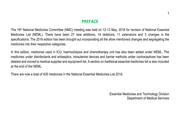
In this edition, medicines used in ICU, haemodialysis and chemotherapy unit has also been added under NEML. The medicines under disinfectants and antiseptics, intrauterine devices and barrier met
...
This guideline covers making people aware of how to correctly use antimicrobial medicines (including antibiotics) and the dangers associated with their overuse and misuse. It also includesmeasures t
...
Licensed pharmaceutical products (marketing authorization) should be manufactured only by licensed manufacturers (holders of a manufacturing authorization) whose activities are regularly inspected by competent national authorities. This guide to GMP
...
The manufacturing process is one of the key steps where quality control is required to ensure quality of medicinal products, including herbal medicines
...
Global Action Plan on Antimicrobial Resistance
recommended
The goal of the draft global action plan is to ensure, for as long as possible, continuity of successful treatment and prevention of infectious dis
...
Disinfection of drinking-water supplies has been one of the most significant public health advancements of the last century with respect to reducin
...
In recent years, high prices of pharmaceutical products have posed challenges in high- and low-income countries alike. In many instances, high prices of pharmaceutical products have led to significa
...
Antimicrobials are medicines, including antibiotics, antivirals, antifungals, and antiparasitics, that are used to prevent and treat infections in humans, animals, and plants. Antimicrobial Resistance (AMR) arises when bacteria, viruses, fungi, and
...
Review over the work and challenges of the Nigerian National Agency for Food and Drug Administration and Control (NAFDAC) in combatting counterfeiting of
...
The recommendations cover the level of blood pressure to start medication, what type of medicine or combination of
...

Cryptococcal disease is one of the most common opportunistic infections among people living with advanced HIV disease and is a major contributor to severe illness, morbidity, and mortality, particularly in sub-Saharan Africa.
These guidelines up
...

This document was prepared in response to a need to review and potentially update the current recommendations for the antibiotic treatment of both inpatient and outpatient management of severe acute
...
Fact Book on WHO Level I and Level II monitoring indicators - To monitor the progress of efforts to improve the global medicines situation, WHO has developed a system
...
The World Heart Federation (WHF) Roadmap series covers a large range of cardiovascular conditions. These Roadmaps identify potential roadblocks and their solutions to improve the prevention, detection and management
...
How to address the global crisis in antibiotic research and development.
The report includes a comprehensive summary and critical evaluation of recent initiatives to overcome the barriers to achieve sustainable access to antibiotics. As antibiotic
...
Antimicrobial resistance (AMR) is a threat to global health and development and it contributes to millions of deaths worldwide each year. Inappropriate use and overuse of antibiotics are driving an
...
WHO Guidelines for malaria
recommended
25 Nov 2022
The WHO Guidelines for malaria bring together the Organization’s most up-to-date recommendations for malaria in one user-friendly and easy-to-navigate online platform.
The WHO Guidelines for malaria supersedes 2 previous WHO publications: the Guidelines for the treatment
...
A survey was conducted in countries in all six WHO regions and focused on the building blocks that are considered prerequisites to combat antimicrobial resistance: a comprehensive national plan, laboratory capacity to undertake surveillance for resistant microorganisms, access to safe, effective ant
...
The WHO CIA List should be used as a reference to help formulate and prioritize risk assessment and risk management strategies for containing antimicrobial resistance. The WHO CIA List supports strategies to mitigate the human health risks associated with antimicrobial use in
...
August 2020, The Africa Joint Continental Strategy for COVID-19 is underpinned by the need to limit transmission, prevent deaths and reduce associated harms. Participation by African nations in clinical trials is an essential step to ensure that sufficient data is generated on the safety and
...
Malaria vaccine: WHO position paper - March 2022
recommended
Weekly Epidemiological Record No 9, 2022, 97, 61–80
This position paper supersedes the 2016 publication, “Malaria vaccine: WHO position paper-2016.”1 It includes the updated WHO recommendations on the wider use of the RTS,S/AS01 vaccine for t
...
Namibia guideline for submission of applications for registration of pharmaceuticals for human use in common technical document format.
Access to controlled medicines. 3rd edition

The main objective of the malaria prevention and control programme in Somalia is to prevent mortality and reduce morbidity due to malaria. The groups most vulnerable to the disease, children aged under 5 years and pregnant women, are especially targ
...
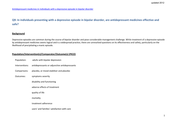
Q9: Antidepressant medicines in individuals with a depressive episode in bipolar disorder1Q9: In individuals presenting with a depressive episode in bipolar disorder, are antidepressant medicines ef
...
