
Filter
82
Text search:
acaps
Featured
Recommendations
9
New Publications
47
Language
Document type
No document type
48
Studies & Reports
15
Guidelines
6
Manuals
3
Situation Updates
3
Strategic & Response Plan
2
Fact sheets
2
Training Material
1
Resource Platforms
1
Infographics
1
Countries / Regions
Sierra Leone
12
Liberia
6
Western and Central Europe
5
Bangladesh
4
Guinea
3
Congo, Democratic Republic of
3
Syria
3
Myanmar / Burma
3
Yemen
3
South Sudan
2
Ukraine
2
Global
2
Zimbabwe
1
Haiti
1
Philippines
1
Nepal
1
Pakistan
1
Iraq
1
Afghanistan
1
Kenya
1
Rwanda
1
Indonesia
1
Mozambique
1
Central African Republic
1
Croatia
1
Middle East and North Africa
1
Asia
1
Venezuela
1
Eastern Europe
1
Authors & Publishers
Publication Years
Category
Countries
21
Key Resources
12
Capacity Building
2
Public Health
2
General Guidelines
2
Toolboxes
Ebola
16
COVID-19
10
Natural Hazards
9
Rapid Response
6
Refugee
6
Conflict
5
Disability
1
Cholera
1
Zika
1
Specific Hazards
1
Planetary Health
1
Pharmacy
1
Conflict
In early October, Ukrainian forces continued recapturing areas of southern and eastern oblasts, notably Lyman (Donetsk oblast). The liberation of thousands of square kilometres resulted in the grim discovery of two new mass graves in Lyman and Sviatohirsk (containing of 120 civilian bodi
...
This paper brings together lessons from interviews with humanitarians and local responders, as well as existing literature, about the use of quarantine in urban environments during the humanitarian response to the Ebola Crisis
The magnitude of urban disasters, high population densities, and a complex social, political and institutional environment has challenged the manner in which humanitarian agencies are used to working. Humanitarian agencies are now grappling with how to change their approaches to this reality. This d
...
Guide to community engagement in WASH
recommended
A practioner's guide, based on lessons from Ebola.
This guide is a compilation of best practices and key lessons learned through Oxfam’s experience of community engagement during the 2014–15 Ebola response in Sierra Leone and Liberia. It aims to inform public health practitioners and programme
...
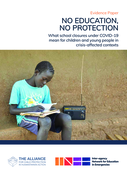
What school closures under COVID-19 mean for children and young people in
crisis-affected contexts
The number of new Ebola infections in Sierra Leone is declining, despite the outbreak continuing to claim lives. New cases have dropped to around 9-12 per week, according to recent WHO figures. There were over 500 cases per week at the height of the crisis around late November 2014.
The impact on t
...
In the aftermath of the April 2015 earthquake in Nepal, this paper looks at lessons drawn from previous comparable disasters and seeks to provide invaluable information and assistance to the operational agencies responding to the crisis.

The Guide has been developed to enhance the knowledge capabilities of NDMAs and their local partners. This is accomplished by exposing them to the existing tools and services developed by the international community to facilitate effective disaster response to any scale of disaster (small, medium an
...

How should humanitarian organisations prepare and respond to COVID-19 in humanitarian settings in low- and middle-income countries?
This Rapid Learning Review outlines 14 actions, insights and ideas for humanitarian actors to consider in their COVID-19 responses. It summarises and synthesises the
...
Dans ce rapport, le Partnership for Evidence-Based Response to COVID-19 (PERC), un consortium d’organisations mondiales de santé publique et d’entreprises privées, fait la synthèse des résultats d’une enquête conduite du 29 mars au 17 avril 2020 dans 28 villes des États Membres de l’UA
...
A new survey on the impact of the floods in Pakistan on older people reveals that hundreds of lives are needlessly being put at risk due to the decimation of health services and the rise of diseases like malaria and diarrhoea, which can be killers to older people with weaker immune systems.
Possible developments in transit countries over the next 6 months, 24 March 2016
Руководство ВОЗ по политике и практике информирования о рисках при чрезвычайных ситуациях (ИРЧС)
