
Filter
437
Text search:
ICRC
Featured
Recommendations
54
New Publications
149
Language
Document type
No document type
281
Guidelines
42
Studies & Reports
38
Manuals
35
Situation Updates
11
Training Material
9
Strategic & Response Plan
9
Fact sheets
7
Infographics
2
Dashboards/Maps
1
Resource Platforms
1
Online Courses
1
Countries / Regions
Syria
26
Myanmar / Burma
18
Congo, Democratic Republic of
13
South Sudan
13
Bangladesh
11
Guinea
9
Ukraine
9
Sierra Leone
8
Nepal
8
Kenya
8
Liberia
7
Western and Central Europe
7
Nigeria
6
Indonesia
6
Yemen
6
Venezuela
6
Global
6
Ethiopia
5
Uganda
5
Haiti
4
Philippines
4
Central African Republic
4
Colombia
4
Senegal
3
Iraq
3
Jordan
3
Peru
3
Russia
3
Mali
2
Côte d’Ivoire / Ivory Coast
2
India
2
Gambia
2
Rwanda
2
Brazil
2
Croatia
2
Burundi
2
Honduras
2
El Salvador
2
Asia
2
Africa
2
Eastern Europe
2
Guinea-Bissau
1
Cameroon
1
Togo
1
Zimbabwe
1
Somalia
1
Pakistan
1
Afghanistan
1
Germany
1
Lebanon
1
Zambia
1
Turkey
1
Chad
1
Cambodia
1
South Africa
1
Mozambique
1
Sudan
1
Benin
1
Vanuatu
1
Argentina
1
Dominican Republic
1
Namibia
1
Eswatini/ Swaziland
1
Hungary
1
Ecuador
1
Botswana
1
Bolivia
1
Greece
1
Guatemala
1
Madagascar
1
Lesotho
1
Mexico
1
Nicaragua
1
Middle East and North Africa
1
Western Pacific Region
1
Latin America and the Carribbean
1
Eastern Europe and Central Asia
1
Poland
1
Palestine
1
Laos
1
Romania
1
Moldova
1
Belarus
1
Authors & Publishers
Publication Years
Category
Countries
104
Key Resources
63
Women & Child Health
20
Public Health
18
Clinical Guidelines
18
Capacity Building
11
Pharmacy & Technologies
2
General Guidelines
1
Toolboxes
Conflict
75
COVID-19
47
Ebola
31
Natural Hazards
26
Mental Health
24
Refugee
23
Disability
22
Rapid Response
18
Specific Hazards
14
TB
13
Planetary Health
7
Global Health Education
5
Pharmacy
5
Zika
4
Caregiver
4
Cholera
3
HIV
3
Typhoon
1
NTDs
1
Health Financing Toolbox
1
A manual intended for medical and other personnel responsible for humanitarian activities in armed conflicts. It covers the following topics: setting up a health-care system that meets the essential needs of war victims, particularly of displaced persons; public health tools most frequently used for
...
A practical manual presenting the specific knowledge, skills and practices that First Aiders should have to act safely and effectively when caring for people caught up in armed conflicts and other situations of violence, such as internal disturbances and tensions.
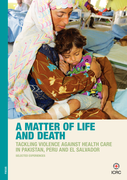
Every day, health-care providers are being attacked, patients discriminated against, ambulances held up at checkpoints, hospitals bombed, medical supplies looted and entire communities cut off from critical services around the world.
Between January 2012 and December 2014, the ...
Between January 2012 and December 2014, the ...
New E-learning on health care responsibilities in times of conflict
Are you a doctor wondering how to interact with the media, or a nurse wondering how to treat patient information in difficult circumstances? Are you an ambulance driver unsure of what your responsibilities are? Are you a hospital a
...
Professional Standards for Protection Work
recommended
Carried out by humanitarian and human rights actors in armed conflict and other situations of violence
This guideline (third edition) constitutes a set of minimum but essential standards aimed at ensuring that protection work is safe and effective. The standards reflect shared thinking and common
...
This guidelines is aimed at humanitarian and human rights actors engaged in protection work, and is intended to act as an easy reference to the minimum standards to be met and the recommended guidelines to be followed in such work.
The 45 standards and 15 guidelines are reproduced in full, together
...
Management of Dead Bodies After Disasters: A Field Manual For First Responders. Second Edition
recommended
Proper and dignified management of the dead in disasters is one of the three key pillars of humanitarian response and a fundamental factor in facilitating identification of the deceased and helping families discover the fate of their loved ones. This second and updated edition of this hugely success
...
في النزاعات المسلحة وغيرها من حالات العنفالتي تنفذها الجهات الفاعلة في مجالي العمل الإنساني وحقوق الإنسان
La cirugía que se realiza en víctimas de una situación de conflicto armado es en general diferente a las que se efectúan en tipos diversos de trauma. Las heridas originadas en conflictos armados son causadas por balas o fragmentos de la explosión de minas o bombas y siempre se consideran lesion
...
Entraînement à la marche. Un excellent exercice pour les personnes amputées des membres inférieurs
The Humanitarian Pandemic Preparedness (H2P) Initiative and its many partners have developed ready-to-use training curricula for district- and community-level leaders, and community volunteers and workers in order to minimize morbidity and mortality in the event of an influenza pandemic. The time t
...
Management of Dead Bodies After Disasters: A Field Manual For First Responders. (Arabic Version)
recommended
Second edition. This revised edition incorporates experience gained in recent catastrophes, such as the 2013 Typhoon Haiyan in the Philippines, the 2014/15 Ebola epidemic in West Africa and the 2015 earthquake in Nepal. It also contains a number of annexes, which cover such topics as handling the bo
...
La gestión de cadáveres en situaciones de desastre: Guía práctica para equipos de respuesta
recommended
Segunda edición (revisada). Este manual tiene dos objetivos: en primer lugar, promover la gestión apropiada y digna de los cadavers y, en segundo lugar, facilitar su identificación. Luego de muchos desastres, en particular los de mayor magnitud, la recuperación y la gestión inmediata de los cad
...
Proper and dignified management of the dead in disasters is one of the three key pillars of humanitarian response and a fundamental factor in facilitating identification of the deceased and helping families discover the fate of their loved ones. This second and updated edition of this hugely success
...

Many migrants find themselves with limited access, if any, to information about risks, prevention measures, health care and other essential services. Migrants in transit, those in need of international protection or without legal status are likely to be particularly vulnerable, as well as those who
...
