Filter
718
Text search:
emergency
medicine
specialists
Featured
68
184
Language
Document type
407
107
88
63
30
7
6
4
2
1
Countries
50
30
25
25
21
19
18
17
13
13
12
11
11
11
10
10
10
9
9
8
8
7
7
6
6
6
5
5
5
5
5
5
5
4
4
4
4
4
3
3
3
3
2
2
2
2
2
2
2
2
2
2
2
2
1
1
1
1
1
1
1
1
1
1
1
1
1
1
1
1
1
1
1
1
1
1
1
1
1
1
1
1
1
1
1
1
1
1
1
1
Authors & Publishers
Publication Years
Category
263
76
54
30
26
11
1
1
Toolboxes
83
40
38
36
34
34
33
25
23
19
16
16
16
15
14
10
9
8
4
4
3
3
2
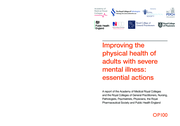
This report, written in partnership with various Royal Medical Colleges and Public Health England, sets out the essential actions to improve the physical health of adults with severe mental illness (SMI) across the NHS. The report makes practical recommendations for changes that will help adults wit
...
WHO mhGAP Guideline update
recommended
Update of the Mental Health Gap Action Programme
(mhGAP) Guideline for Mental, Neurological and Substance use Disorders May 2015
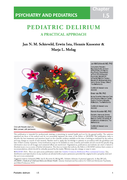
Psychiatry and Pediatrics
Chapter I.5

In the course of implementing a recently funded network of hubs for building capacities in mental health service development, training, and research (RedeAmericas), the peer support workers are being introduced into the mental health workforce in three Latin American countries for the very first tim
...
The 2019 edition treating data for 2018 marks sustained international efforts dedicated to reporting on, analysing and understanding the year-to-year variations and long-term trends of a changing climate.
The seven essential features of practice for scaling up are described with great clarity. They are practical and universal, and encourage local innovation. They include policy, funding and local management structure, as well as working with all possible partners and developing local context adaptati
...
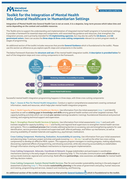
This Toolkit aims to support the understanding and implementation of integrated mental health programs in humanitarian settings. It provides a framework for essential steps and components, with associated key guidance and resources, that strengthen the integration process, and is primarily intended
...
The WHO Toolkit for the care and support of people affected by complications associated with Zika virus has been developed to serve as a model guide, with the goal of enhancing country preparedness for Zika virus outbreaks. The toolkit is intended to provide a systems approach involving public heal
...
During the past five decades, the incidence of dengue has increased 30-fold. Some 50–100 million new infections are estimated to occur annually in more than 100 endemic countries, with a documented further spread to previously unaffected areas; every year hundreds of thousands of severe cases ari
...
The EYE strategy is a comprehensive and long-term strategy built on lessons learned that aims at ending yellow fever epidemics by 2026, and consists of three strategic objectives:
protect at-risk populations;
prevent international spread; and
contain outbreaks rapidly.
10 years after the UN general assembly special session on drugs
Evaluation report
December 2014
1-13 December 2018 | Geneva, Switzerland UNAIDS Programme Coordinating Board Issue date: 23 November 2018
UNAIDS/PCB (43)/18.32
Technical Brief
Damon Barrett, Gonçalo Figueiredo Augusto, Martiani Oktavia, Jeanette Olsson, Mira Schneiders and Kate Welch provided background papers and literature reviews which informed this technical series.
Consolidated Guidelines
Geneva, 2016
The End TB Strategy