
Filter
658
Text search:
Department
for
International
Development
(DFID)
Featured
Recommendations
48
New Publications
307
Language
Document type
No document type
548
Studies & Reports
71
Manuals
14
Guidelines
10
Strategic & Response Plan
9
Training Material
2
Resource Platforms
2
Situation Updates
1
Fact sheets
1
Countries / Regions
Nepal
50
Nigeria
49
Kenya
49
Sierra Leone
42
Ethiopia
26
Zambia
24
Malawi
24
Myanmar / Burma
23
Uganda
21
India
19
Ghana
16
Liberia
13
Congo, Democratic Republic of
12
Zimbabwe
12
Bangladesh
12
South Africa
11
Global
11
Tanzania
10
Mozambique
8
Guinea
6
Senegal
5
South Sudan
5
Haiti
4
Syria
4
Rwanda
4
Indonesia
4
Lesotho
4
Burkina Faso
3
Mali
3
Pakistan
3
Cambodia
3
South–East Asia Region
3
Niger
2
Somalia
2
Brazil
2
Libya
2
Yemen
2
Asia
2
Africa
2
Tajikistan
2
Tunisia
2
Algeria
2
Cameroon
1
Philippines
1
Iraq
1
Jordan
1
Afghanistan
1
Germany
1
Lebanon
1
Chad
1
Gambia
1
Sudan
1
Benin
1
Central African Republic
1
Namibia
1
Eswatini/ Swaziland
1
Croatia
1
Ukraine
1
Botswana
1
El Salvador
1
East and Southern Africa
1
Middle East and North Africa
1
Latin America and the Carribbean
1
Western and Central Europe
1
Bhutan
1
Eastern Europe
1
Mongolia
1
Vietnam
1
Authors & Publishers
Publication Years
Category
Countries
382
Key Resources
46
Women & Child Health
24
Public Health
15
Clinical Guidelines
10
Capacity Building
6
Pharmacy & Technologies
3
Toolboxes
Disability
38
Ebola
29
HIV
23
Mental Health
23
Natural Hazards
17
COVID-19
16
TB
15
Conflict
12
Health Financing Toolbox
11
Global Health Education
10
Planetary Health
10
Rapid Response
8
AMR
8
Pharmacy
8
NTDs
7
Refugee
5
Cholera
2
Caregiver
2
Polio
1
South Sudan
1
Zika
1
Social Ethics
1
NCDs
1
The objectives of the meeting were to agree on coordinated and aligned support to the 3 countries’ national health recovery plans (Guinea, Liberia, Sierra Leone); to identify cross-cutting areas and opportunities for integration; to identify ways
...
Transforming Health: Accelerating attainment of Health Goals | THE SECOND MEDIUM TERM PLAN FOR HEALTH
The Government of Malawi, in fulfilling its primary role of protecting the lives of its vulnerable citizens during disasters and reducing their exposure to risk through preparedness, led the development of a National Coronavirus Disease (COVID-19) P
...
The health sector In Ukraine is beginning to change in recent years. The sector, based on a system of health care (Semashko) originating from the Soviet Union, had been stagnant for many years. Remarkably little had changed since Independence and th
...
n Autumn 2013, HHI Executive Director, Vincenzo Bollettino, traveled to the Philippines to participate in an assessment of civil-military engagement in the humanitarian response to Typhoon Haiyan. The report was sponsored by the Center for Excellenc
...
War Trauma Foundation strengthens mental health care and psychosocial support through capacity building and development and dissemination of expertise through the implementation of programmes in (post) conflict areas. We develop and evaluate new met
...
Nepal has made substantial progress in reducing under-five mortality and is on track to achieve Millennium Development Goal 4, but advances in neonatal health are less encouraging. The objectives of this study were to assess relative and absolute in
...
The survey highlights changes that have taken place in Bangladesh’s demographic and health situation since the previous BDHS surveys. The survey provides important information for policymakers and program personnel in addressing the monitoring and
...
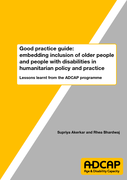
Lessons learnt from the ADCAP programme | This guide shares good practices and challenges that have emerged through the experience of the Age and Disability Capacity Programme (ADCAP) implementing partners, in embedding inclusion of older people and people with disabilities within their humanitaria
...
This evaluation is the first systematic effort by UNICEF to generate evidence on how well its global as well as country level Community Management of Acute Malnutrition (CMAM) strategies have worked, including their acceptance and ownership in various contexts and appropriateness of investments in c
...

The objectives of this guidance document are to:
1. Strengthen the capacity of country teams to effectively scale up and manage programmes to address severe acute malnutrition
2. Extend the geographic reach of quality treatment for SAM to ...
1. Strengthen the capacity of country teams to effectively scale up and manage programmes to address severe acute malnutrition
2. Extend the geographic reach of quality treatment for SAM to ...

Census data shows that Myanmar can harness a double dividend – both youth and gender. This year’s annual report provides many facets of the journey to gender equality. It tells a story of widening horizons for women and girls who are capable in
...

The overall goal of the Kenya Health Sector Referral Strategy is to improve client access to referral. The objectives of the strategy are to realise improved capacity of health providers to identify clients who require referral, develop protocols that will lead to referral system efficiency and effe
...

The BRACED Myanmar Alliance was a three-year project aiming to ‘build the resilience of 350,000 people across Myanmar to climate extremes’. The project worked in 7 states, 8 townships and 155 communities. The main impact for project populations
...
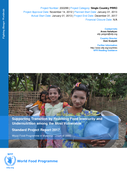
In view of the ongoing political, peace and reconciliation, administrative and economic reforms as well as plans to establish the United Nations Development Assistance Framework (UNDAF) in 2018, WFP extended the current Protracted Relief and Reco
...
. To echo this extension and provide a more appropriate response to the country's rapid and multi-pronged transition, WFP adopted a transition strategy with gradually reduced emphasis on humanitarian assistance and greater focus on early recovery and development interventions. WFP's strategic engagement in-country was driven by the overarching goal to assist Myanmar to achieve the national Zero Hunger Challenge by 2025, and was guided by three priorities: emergency preparedness and response; nutrition; and provision of social safety nets.

COP24 special report: health and climate change
recommended
Exposure to air pollution causes 7 million deaths worldwide every year and costs an estimated US$ 5.11 trillion in welfare losses globally. In the 15 countries that emit the most greenhouse gas emissions, the health impacts of air pollution are estimated to cost more than 4% of their GDP. Actions to
...
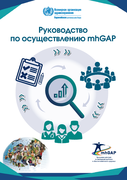
Руководство по осуществлению mhGAP
recommended
The WHO Mental Health Gap Action Programme (mhGAP) aims at scaling up mental health services in non-specialized health settings to achieve universal health coverage. The mhGAP operations manual is an integral component of the mhGAP package and supports district health managers and others responsible
...
In recent years, high prices of pharmaceutical products have posed challenges in high- and low-income countries alike. In many instances, high prices of pharmaceutical products have led to significant financial hardship for individuals and negativel
...

This field study to measure access to and use of medicines was undertaken in GHANA in May-June 2008. The study assessed information on the socio-economic level of households, and access to and use of medicines for acute and c
...
The Global Reference List of 100 Core Health Indicators is a standard set of core indicators prioritized by the global community to provide concise information on the health situation and trends, including responses at national and global levels.
This second (2018) edition builds on the previous
...
