
Filter
307
Text search:
United
Nations
Children’s
Fund
(UNICEF)
Featured
Recommendations
18
New Publications
85
Language
Document type
No document type
175
Studies & Reports
66
Guidelines
19
Fact sheets
13
Manuals
11
Infographics
10
Situation Updates
7
Strategic & Response Plan
4
Training Material
1
Videos
1
Countries / Regions
Global
22
Kenya
10
Syria
8
Ethiopia
7
Namibia
7
Myanmar / Burma
7
South Sudan
6
Lesotho
6
Rwanda
5
Bangladesh
5
South–East Asia Region
5
Senegal
4
Congo, Democratic Republic of
4
Lebanon
4
Zambia
4
Tanzania
4
Indonesia
4
Mali
3
Uganda
3
India
3
Somalia
3
Nepal
3
Mozambique
3
Yemen
3
West and Central Africa
3
Latin America and the Carribbean
3
Western and Central Europe
3
Nigeria
2
Philippines
2
Jordan
2
Egypt
2
Cambodia
2
South Africa
2
Central African Republic
2
Ukraine
2
East and Southern Africa
2
Middle East and North Africa
2
Eastern Europe
2
Guinea
1
Burkina Faso
1
Sierra Leone
1
Liberia
1
Guinea-Bissau
1
Ghana
1
Niger
1
Haiti
1
Pakistan
1
Iraq
1
Afghanistan
1
Germany
1
Turkey
1
Chad
1
Malaysia
1
Malawi
1
Argentina
1
Colombia
1
Greece
1
Libya
1
Mexico
1
Sri Lanka
1
Western Pacific Region
1
Eastern Europe and Central Asia
1
Africa
1
Venezuela
1
Albania
1
Laos
1
Vietnam
1
Authors & Publishers
Publication Years
Category
Countries
116
Women & Child Health
65
Key Resources
11
Clinical Guidelines
5
Capacity Building
3
Public Health
3
Pharmacy & Technologies
1
Toolboxes
Disability
56
Mental Health
31
COVID-19
21
Conflict
19
HIV
19
Planetary Health
18
Refugee
6
Pharmacy
5
Caregiver
4
Polio
3
Global Health Education
3
Natural Hazards
2
Specific Hazards
2
Rapid Response
1
Zika
1
TB
1
AMR
1
his publication provides an overview of social inequalities in several indicators related to the health of women, children, and adolescents in a region deemed as one with high levels of inequality: Latin America and the Caribbean (LAC). In order for it to serve as a baseline for the 2030 Agenda, emp
...

This report from Human Rights Watch found that South Africa has failed to guarantee the right to education for many of the country’s children and young adults due to widespread discrimination against children with disabilities in enrollment decisions. Human Rights Watch research in five out of Sou
...
The Priority medicines for mothers and children 2011 list was updated following the 18th Expert Committee Meeting
on Selection and Use of Medicines, the release of new treatment guidelines and feedback from partners following
the 2011 version. In alignment with the UN Global strategy f
...
The new Global Strategy aims to achieve the highest attainable standard of health for all women, children and adolescents, transform the future and ensure that every newborn, mother and child not only survives, but thrives.
In 2015, 5.9 million children under age five died (1). The major causes of child deaths globally are pneumonia, prematurity, intrapartum-related complications, neonatal sepsis, congenital anomalies, diarrhoea, injuries and malaria (2). Most of these diseases and conditions are at least partially cau
...
Special Issue: Special Education in Sub-Saharan Africa | This special issue of our Communication*Support*World*Network*Newsletter attempts to share practical ideas and information about special education for children with disabilities in sub-Saharan Africa. Our intent is to begin a dialogue among th
...
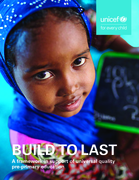
Today, the world is facing a learning crisis: While millions of children have entered education systems for the first time, many of them cannot read, write or do basic mathematics, even after several years of primary school.1 This global learning crisis has its roots in
...
Submitted to the US Agency for International Development by the
Systems for Improved Access to Pharmaceuticals and Services (SIAPS) Program.
This manual provides a framework to identify problems and design interventions to improve access to and use of medicines for children. It is a resource for
...
Technical brief by the H4+ (UNAIDS, UNFPA, UNICEF, UN Women, WHO and the World Bank)
The report focuses on several key areas where health outcomes are falling short, and provides insight into ways in which countries can improve the situation for their children and adolescents. Areas in focus include mental health, overweight/obesity and adolescent risk-taking behaviour.
The report
...
Outstanding child and adolescent TB priorities include the need to: find the missing children with active TB and link them to TB care; prevent TB in children who are in contact with infectious TB cases (through implementation of active contact investigation and provision of preventive treatment); an
...
Despite the increasing population of refugees stuck in protracted situations and our awareness of the vulnerability of children and adolescents growing in up these contexts, relatively little is known about community based child protection mechanisms (CBCPMs) in refugee communities. CBCPMs, defined
...

At the threshold of Sustainable Development Goals (SDG) era, this document captures the remarkable achievements by Member States towards achieving MDGs 4 and 5. It acknowledges new opportunities in the post-2015 phase shaped by the SDGs and the Global Strategy for women’s,
...

A companion to the Child Friendly Schools Manual
WASH in Schools aims to improve the health and learning performance of school-aged children – and, by extension, that of their families – by reducing the incidence of water and sanitation-related diseases. Every child friendly school r ...
WASH in Schools aims to improve the health and learning performance of school-aged children – and, by extension, that of their families – by reducing the incidence of water and sanitation-related diseases. Every child friendly school r ...
Noma (cancrum oris) is a severe gangrenous disease of the mouth and face. It mostly affects children between the ages of 2 and 6 years living in extreme poverty. In addition to the known factors such as malnutrition, lack of vaccination in children and poor oral hygiene, several social and environme
...
