
Filter
606
Text search:
Ministry
of
Public
Health
and
Sanitation,
Kenya
Featured
Recommendations
47
New Publications
163
Language
Document type
No document type
335
Studies & Reports
137
Guidelines
44
Strategic & Response Plan
38
Manuals
24
Situation Updates
12
Training Material
9
Fact sheets
6
Online Courses
1
Countries / Regions
Kenya
150
Global
32
Ethiopia
27
Uganda
26
Africa
21
Malawi
16
Sierra Leone
15
Congo, Democratic Republic of
15
Rwanda
15
Tanzania
13
Liberia
12
Nigeria
11
South Sudan
11
Zambia
10
South Africa
10
Mozambique
8
Guinea
7
Madagascar
6
East and Southern Africa
6
Ghana
5
Zimbabwe
5
Somalia
5
Bangladesh
5
Senegal
4
Nepal
4
Pakistan
4
Cambodia
4
Central African Republic
4
Namibia
4
Botswana
4
West and Central Africa
4
Togo
3
Jordan
3
Syria
3
Indonesia
3
Benin
3
Eswatini/ Swaziland
3
Lesotho
3
Myanmar / Burma
3
Burkina Faso
2
Mali
2
Côte d’Ivoire / Ivory Coast
2
India
2
Lebanon
2
Gambia
2
Sudan
2
Burundi
2
Yemen
2
Middle East and North Africa
2
South–East Asia Region
2
Western and Central Europe
2
Asia
2
Guinea-Bissau
1
Morocco
1
Saudi Arabia
1
Cameroon
1
Niger
1
Haiti
1
Iraq
1
Afghanistan
1
Germany
1
Chad
1
Thailand
1
China
1
North Macedonia
1
Colombia
1
Greece
1
Angola
1
Mexico
1
Western Pacific Region
1
Latin America and the Carribbean
1
Eastern Europe and Central Asia
1
Palestine
1
Albania
1
Laos
1
Iran
1
Georgia
1
Vietnam
1
Japan
1
Mauritius
1
Tunisia
1
Authors & Publishers
Publication Years
Category
Countries
285
Key Resources
45
Public Health
38
Women & Child Health
28
Clinical Guidelines
27
Capacity Building
12
Pharmacy & Technologies
1
Toolboxes
COVID-19
39
Disability
35
Planetary Health
35
AMR
29
HIV
28
Ebola
25
Caregiver
24
Rapid Response
23
Conflict
17
TB
17
Mental Health
15
Global Health Education
15
NTDs
15
Refugee
13
Natural Hazards
11
Cholera
9
Health Financing Toolbox
6
NCDs
3
Specific Hazards
2
Social Ethics
2
Pharmacy
2
Polio
1
Health Financing
1
Recent systematic reviews and meta-analysis of the impact of chemical-based mollusciciding (King et al., 2015, Sokolow et al., 2016) have concluded
...
Burden of T. solium: Neurocysticercosis is a disease induced by T. solium larvae penetrating human tissues, especially the nervous system. Neurocysticercosis burdens economies, societies and individ
...
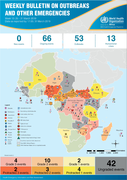
Response to the tropical cyclone in southern Africa
Ebola virus disease outbreak in the Democratic Republic of the Congo
Meningitis outbreak in Togo
Lassa fever outbreak in Liberia.
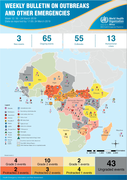
Cyclone in Mozambique and Zimbabwe
Ebola virus disease in Democratic Republic of the Congo
Humanitarian crisis in Mali
Humanitarian crisis in Central African Republic.
Kenya reported its first case of COVID-19 on 12 March 2020 and, as at 7 April 2020, 172 cases had been confirmed
...

Despite the significant role of vector control in national leishmaniasis control programmes, the programmatic community perceives vector control as the weakest component of leishmaniasis control str
...
Significant progress has been made in the eradication of three priority diseases in the African Region, as a result of extensive collaboration between the Regional Office, WHO country offices
...
While there has been real progress in addressing the burden of disease in the WHO African region, the COVID-19 pandemic has highlighted the link between health, economics
...

Cholera is a major health risk in many parts of the world, affecting millions of people every year. Since mid-2021, the world has been facing an ac
...

The Sustainable Development Goals (SDGs) call for major societal transformations that will require significant fiscal outlays as well as private investments. The fiscal outlays cover public investments, the
...
WHO published the first COVID-19 Strategic Response and Preparedness Plan (SPRP) on 3 February, 2020. This report highlights the main points of progress that were made up to 30 June 2020 under the t
...
In 2015, to advance the global and national response to antimicrobial resistance (AMR), the World Health Assembly issued resolution WHA68.7 calling for all Member States to develop AMR national acti
...
The report reveals that good IPC programmes can reduce health care infections by 70 %. oday, out of every 100 patients in acute-care hospitals, seven patients in high-income countries
...
This document builds on the Background document prepared for the September 4-5, 2014 Consultation. It includes proposed elements to consider during the development of a framework to assist decision-making at global
...
Healthy Settings, a key component of Malawi’s Health Sector Strategic Plan (HSSP) 2011–2016, is the World Health Organization’s (WHO) holisti
...

Just about everyone has experienced the joy that a healthy newborn child brings to parents, families and communities. But the arrival of a newborn who is small or sick often results in immediate wor
...

Ebola disease and Marburg disease outbreaks continue to occur in Africa, with increased frequency. In addition to resulting in high mortality and morbidity, the outbreaks generate fear
...
This paper was developed to support AMR coordination committees and others tasked with addressing AMR at country level to do just that. Drawing on the published literature and the operational experi
...

To complement the Global Strategy progress reporting, this report provides a detailed look at country leadership and action toward the Every Newborn National Milestones by 2020. Countries have taken the initiative to show the way forward
...
