Filter
324
Text search:
intubation
Featured
68
61
Language
Document type
124
122
23
21
10
9
5
4
2
2
1
1
Countries / Regions
39
8
8
8
7
6
6
5
5
5
5
4
4
4
4
4
4
3
3
3
3
3
2
2
2
2
2
1
1
1
1
1
1
1
1
1
1
1
1
1
1
1
1
1
1
1
1
1
1
1
1
1
1
1
1
1
1
1
1
1
1
1
1
1
Authors & Publishers
Publication Years
Category
126
75
31
12
8
2
2
Toolboxes
106
30
16
14
12
8
6
5
4
4
3
2
2
2
2
1
1
1
1
1

There is no secret to our procedure: the daily scanning of the literature helps us to stay afloat in the never-ending waves of new publications about SARS-CoV-2 and COVID-19. Many papers discussed in the Top 10 will eventually make it into subsequent editions of COVID Reference.
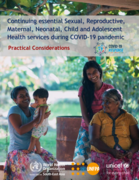
Practical considerations
It provides more detailed and practical guidance for continuing services for each life stage across the life-course continuum. As such, both documents should be read and used together. The countries in South-East Asia and the Pacific regions would like to adapt the guidance
...

Just about everyone has experienced the joy that a healthy newborn child brings to parents, families and communities. But the arrival of a newborn who is small or sick often results in immediate worry and sadness. When the infant is at high risk of death or disability, these concerns can be a tremen
...
The WHO COVID-19 Essential Supplies Forecasting Tool (COVID-19-ESFT) is meant to help countries forecast essential supplies for their COVID-19 response including personal protective equipment (e.g., masks and gloves), biomedical equipment for case management (e.g., ventilators and oxygen concentrato
...
Expert Consensus Report for Emergency Centres in
Western Cape
Anaesthesia Tutorial of the Week
This document aims to provide guidance to healthcare facilities and healthcare providers in the European Union/European Economic Area (EU/EEA) and the United Kingdom (UK) on preparedness and infection prevention and control (IPC) measures for the management of possible and confirmed cases of COVID-1
...
Non-pharmaceutical interventions (NPI) are public health measures that aim to prevent and/or control SARS-CoV-2 transmission in the community. As long as there is no effective and safe vaccine to protect those at risk of severe COVID-19, NPI are the most effective public health interventions against
...
There is no secret to our procedure: the daily scanning of the literature helps us to stay afloat in the never-ending waves of new publications about SARS-CoV-2 and COVID-19. Many papers discussed in the Top 10 will eventually make it into subsequent editions of COVID Reference.
A module from the suite of health service capacity assessments in the context of the COVID-19 pandemic, Interim Guidance 20 October 2020.
This self-assessment tool is designed for acute health-care facilities (i.e. tertiary and secondary) but can be modified for the use in long-term care facilities
...
Interim Guidance, 12 July 2021; This tool was developed to assess present and surge capacities for the treatment of COVID-19 in health facilities. It allows health facilities to assess the availability and status of stockout of critical COVID-19 medicines, equipment and supplies on site and to ident
...
Priority medical devices list for the COVID-19 response and associated technical specifications
recommended
23 February 2021
This document describes the medical devices required for the clinical management of COVID-19, selected and prioritized according to the latest available evidence and interim guidelines. This includes: oxygen therapy, pulse oximeters, patient monitors, thermometers, infusion and suc
...
Severe acute respiratory syndrome coronavirus 2 (SARS-CoV‑2) causing coronavirus disease 2019 (COVID-19) has reached pandemic levels;
Patients with cardiovascular (CV) risk factors and established cardiovascular disease (CVD) represent a vulnerable population when suffering from COVID-19;
Patien
...
The conduct of paediatric anaesthesia presents many unique challenges. One of the most striking is the variabilityof behaviour and responses of children and their parents at induction. Behavioural problems, the need for restraint,difficult IV accessandco-morbiditiesadd complexity and
...
Cognizant of the need for standardization of the response for COVID-19, the Federal Ministry of Health prepared this national guideline in an effort to contain the epidemic before it overwhelms the health care facilities. This national guideline is expected to guide policy makers and h
...
The purpose of the review was to assign a cause of death, to ascertain the fac-tors that contributed to the death and to identify any systemic issues that could be addressed to prevent future similar deaths. The perinatal mortality audit process in 2019 provided important insights and evidence-based
...

In resource restriced countries