
Filter
1454
Text search:
gloves
Featured
235
396
Language
Document type
779
304
108
105
43
38
32
22
14
4
3
1
1
Countries
107
100
96
62
43
41
40
37
26
26
24
24
22
20
18
17
17
15
15
14
14
13
13
12
10
10
10
9
9
9
9
9
9
9
8
8
7
7
7
7
6
6
5
5
5
4
4
4
4
4
4
4
4
4
3
3
3
3
3
3
2
2
2
2
2
2
2
2
2
2
2
2
2
2
2
1
1
1
1
1
1
1
1
1
1
1
1
1
1
1
1
1
1
1
1
1
1
1
1
1
1
1
1
1
Authors & Publishers
Publication Years
Category
551
147
99
69
48
47
36
1
1
Toolboxes
308
220
106
73
55
44
33
32
29
26
24
21
20
20
10
8
8
7
7
5
2
1
1

PQDx 0141-051-00 WHO
PQDx Public Report
April/2017, version 5.0

PQDx 0053-006-00 WHO
PQ Public Report
June/2016, version 2.0

PQDx 0181-031-00
WHO PQ Public Report
March/2017, version 3.0

Identification and initial management of cases. Clinical guidance
In response to the COVID-19 outbreak this risk communication package for healthcare facilities provides healthcare workers (HCWs) and healthcare facility management with the information, procedures, and tools required to safely and effectively work. The package contains a series of simplified messag
...

Public Report
PQMC 0003-003-00 WHO PQMC PR June/2015, version 2.0
Infectious diseases are constantly in transition. New diseases develop, known dis-eases become widespread or reemerge, and occasionally a disease is eradicated.Infectious diseases such as HIV, tuberculosis, and cholera are significant causes ofillness and death in many parts of the world. Health car
...
Interim guidance 19 March 2020
The global increase of healthcare-associated infections (HAI) presents a growing concern in healthcare worldwide. According to the European Centre for Disease Prevention and Control (ECDC), the annual number of HAI exceeds 2.6million and produces the highest estimated amou
...
Updated 19 March 2020
Persons with acute respiratory illness with sudden onset of at least one of the following: cough, sore throat, shortness of breath or fever [≥ 38°C (measured) or history of fever (subjective)] irrespective of admission status AND In the 14 days prior to onset of symptoms, met at least one of the
...
Outline
• Welcome and objectives
• Microbiology, epidemiology and clinical presentation
• Surveillance for imported cases including case definitions
• Laboratory diagnosis • Infection prevention and hospital readiness
• Patient flow and actions required at each step
• Co-ord
...
Person under investigation (PUI) form for coronavirus disease 2019 (COVID-19): Request for severe acute respiratory syndrome coronavirus 2 (SARS-CoV-2) testing
and
COVID-19 Contact line list
On the 31st December 2019, the World Health Organization (WHO) China country office reported a cluster of pneumonia cases in Wuhan City, Hubei Province of China now known to be caused by a novel virus. Severe acute respiratory syndrome coronavirus 2 (SARS-CoV-2) has been confirmed as the causative v
...
COVID-19: Guidelines for case-finding, diagnosis, management and public health response in South Africa
recommended
The information contained in this document, be it guidelines, recommendations, diagnostic algorithms or treatment regimens, are offered in this document in the public interest. To the best of the knowledge of the guideline writing team, the information contained in these guidelines is correct. Imple
...
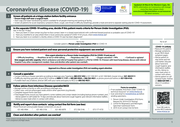
Updated 20 March 2020
This document provides guidance to EU/EEA Member States on environmental cleaning in healthcare and non-healthcare settings during the COVID-19 pandemic.
