
Filter
594
Text search:
World
Health
Organization.
Regional
Office
for
the
Eastern
Mediterranean
Featured
Recommendations
87
New Publications
128
Language
Document type
No document type
220
Studies & Reports
153
Guidelines
104
Manuals
49
Strategic & Response Plan
31
Training Material
10
Situation Updates
9
Fact sheets
7
Resource Platforms
5
Infographics
2
Brochures
1
App
1
Online Courses
1
Videos
1
Countries / Regions
Global
52
Syria
20
Africa
17
Middle East and North Africa
15
Western and Central Europe
13
Somalia
9
Yemen
7
Pakistan
6
Eastern Europe
6
Nigeria
5
Sudan
5
South–East Asia Region
5
Latin America and the Carribbean
5
Sierra Leone
4
Liberia
4
Iraq
4
Jordan
4
Afghanistan
4
Lebanon
4
Myanmar / Burma
4
Saudi Arabia
3
Ethiopia
3
Ghana
3
Kenya
3
Rwanda
3
Iran
3
Senegal
2
India
2
Nepal
2
Turkey
2
Thailand
2
China
2
Ukraine
2
West and Central Africa
2
Asia
2
Venezuela
2
Congo, Democratic Republic of
1
Morocco
1
USA
1
Cameroon
1
Uganda
1
Philippines
1
Egypt
1
Tanzania
1
Cambodia
1
South Africa
1
Bangladesh
1
Benin
1
North Macedonia
1
Croatia
1
Ecuador
1
Greece
1
Libya
1
East and Southern Africa
1
Western Pacific Region
1
Eastern Europe and Central Asia
1
Palestine
1
Albania
1
Djibouti
1
Russia
1
Qatar
1
Georgia
1
Tunisia
1
Authors & Publishers
Publication Years
Category
Clinical Guidelines
85
Countries
74
Public Health
68
Women & Child Health
53
Key Resources
30
Pharmacy & Technologies
13
Capacity Building
12
Toolboxes
Mental Health
75
COVID-19
58
Planetary Health
42
Rapid Response
38
TB
34
HIV
30
Conflict
26
NTDs
26
Refugee
25
Global Health Education
25
AMR
24
Caregiver
22
NCDs
20
Disability
19
Pharmacy
14
Ebola
9
Polio
7
Zika
6
Cholera
5
Natural Hazards
5
Specific Hazards
4
Health Financing Toolbox
4
Typhoon
1
A survey was conducted in countries in all six WHO regions and focused on the building blocks that are considered prerequisites to combat antimicrobial resistance: a comprehensive national plan, laboratory capacity to undertake surveillance
...
The risk communication and community engagement (RCCE) competency framework is a resource that details the essential behaviours and activities necessary f
...
Chapter 1 provides new data on the latest developments in the global treatment effort, highlighting positive trends as well as aspects that require improvement. Chapter 2 summarizes
...
GO pre-deployment training: participant handbook
recommended
This is a pre-deployment training, tailored specially to the Ebola outbreak in West Africa, offered to WHO personnel, consultants, and key partners. The material covered in modules 1-4 is applicable
...
2nd edition - Published in 2003, the first WHO/HAI medicine prices manual Medicine Prices – A
New Approach to Measurement Draft for field-testing provides a draft methodology and tools to conduc
...
WHO has issued a new recommendation on the length of bladder catheterization following surgical repair of a simple obstetric urinary fistula. Currently the length of catheterization is not standard
...
The report provides a global knowledge base on suicide and suicide attempts as well as actionable steps for countries based on their current resources and context to move forward in suicide preventi
...

WHO would like to express its gratitude and appreciation to all Member States that provided information to the WHO survey on policies and activities at the national level in
...
WHO published the first COVID-19 Strategic Response and Preparedness Plan (SPRP) on 3 February, 2020. This report highlights the main points of progress that were made up to 30 June 2020 under
...
The WHO Guidelines on risk reduction of cognitive decline and dementia provide evidence-based recommendations on lifestyle behaviours and interventions to delay or prevent cognitive decline and dementia. These WHO Guidelines are an important tool
...
These guidelines provide new and updated recommendations on the use of point-of-care testing in children under 18 months of age and point-of-care tests to monitor treatment in people living with HIV; the
...
Laboratory biosafety manual
recommended
4th edition
The WHO Laboratory Biosafety Manual (LBM) has been in broad use at all levels of clinical and public health laboratories, and other biomedical sectors globally, serving as a de facto gl
...

The purpose of this handbook is to provide guidance to Member States on the practical aspects of maintaining sanitary standards at international borders at ports, airports, and ground crossings (poi
...
WHO Guideline. Since 2010, countries in the meningitis belt have started to introduce a new serogroup A meningococcal conjugate vaccine conferring individual protection and herd immunity. Following the
...

In fragile, conflict-affected and vulnerable settings, delivery of quality health services faces significant challenges, including disruption of a routine health service
...
The Pandemic Influenza Preparedness (PIP) Framework is a World Health Assembly resolution adopted unanimously by all Member States in 2011. It brin
...
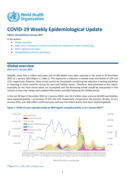
Globally, more than 3 million new cases and 10 000 deaths have been reported in the week of 26 December 2022 to 1 January 2023. This represents a reduction in weekly cases and deaths of 22% and 12%, respectively. In
...
Vitamin D deficiency is thought to be common among pregnant women, particularly during the winter months, and has been found to be associated with an increased risk of pre-eclampsia, gestational diabetes mellitus, preterm birth, and other tissue-spe
...
This guideline provides global, evidence-informed recommendations on daily iron supplementation in infants and children, as a public-health intervention for
...
These guidelines present evidence-based recommendations and best practice statements on use of medically important antimicrobials in food-producing animals, based on the WHO list of critically important antimicrobials
...
