
Filter
723
Text search:
World
Health
Organization
WHO,
PAHO
Featured
Recommendations
72
New Publications
130
Language
Document type
No document type
270
Studies & Reports
157
Guidelines
125
Manuals
53
Strategic & Response Plan
31
Fact sheets
31
Training Material
21
Situation Updates
17
Infographics
8
Online Courses
5
Brochures
3
Resource Platforms
2
Countries / Regions
Latin America and the Carribbean
123
Global
45
Brazil
29
Venezuela
19
Haiti
18
Colombia
16
Mozambique
11
Angola
10
North America
9
Guinea-Bissau
7
Paraguay
7
India
6
Nepal
6
Syria
4
Peru
4
Chile
4
Yemen
4
Middle East and North Africa
4
Asia
4
Africa
4
Ghana
3
Bangladesh
3
Argentina
3
Ukraine
3
Myanmar / Burma
3
Russia
3
Nigeria
2
Philippines
2
South Sudan
2
Zambia
2
Cambodia
2
Thailand
2
China
2
El Salvador
2
East and Southern Africa
2
South–East Asia Region
2
Jamaica
2
Portugal
2
USA
1
Ethiopia
1
Uganda
1
Zimbabwe
1
Turkey
1
South Africa
1
Sudan
1
Benin
1
North Macedonia
1
Honduras
1
Ecuador
1
Bolivia
1
Guatemala
1
Lesotho
1
Mexico
1
West and Central Africa
1
Western Pacific Region
1
Western and Central Europe
1
Eastern Europe
1
Italy
1
Armenia
1
Laos
1
Tajikistan
1
Estonia
1
Moldova
1
Iran
1
Georgia
1
Vietnam
1
Uruguay
1
Japan
1
Belgium
1
Belarus
1
Authors & Publishers
Publication Years
Category
Countries
177
Clinical Guidelines
84
Public Health
52
Key Resources
45
Women & Child Health
36
Capacity Building
12
Pharmacy & Technologies
7
General Guidelines
2
Annual Report MEDBOX
1
Toolboxes
COVID-19
152
Mental Health
66
Rapid Response
52
HIV
47
NTDs
38
Zika
33
Planetary Health
33
NCDs
23
TB
21
Global Health Education
19
Caregiver
19
AMR
17
Natural Hazards
14
Cholera
11
Pharmacy
10
Health Financing Toolbox
10
Conflict
8
Refugee
7
Specific Hazards
6
Disability
5
Ebola
2
Typhoon
2
Polio
1
The COVID-19 Strategic Preparedness and Response Plan (SPRP) 2021 Monitoring and Evaluation Framework tracks global progress against the COVID-19 SPRP 2021 for the ten pillars of the public health response. The operational intelligence complements t
...
9 June 2021
Since its launch, GLASS has expanded in scope and coverage and as of May 2021, 109 countries and territories worldwide have enrolled in GLASS. A key new component in GLASS is the inclusion of antimicrobial consumption (AMC) surveillance at the national level highlighted in this fourth G
...

This document is based on currently available scientific evidence on treatment for drug use disorders and sets out a framework for the implementation of the Standards, in line with principles of public health care. The Standards identify major compo
...
This document aims to describe a minimum set of surveillance activities recommended at the national level to detect and monitor the relative prevalence of SARS-CoV-2 variants and outline a set of activities for the characterization and assessment of risk posed by these variants. A set of indicators
...
The recommendations cover the level of blood pressure to start medication, what type of medicine or combination of medicines to use, the target blood pressure level, and how often to have follow-up checks on blood pressure. In addition, the guideline provides the basis for how physicians and other
...

The meningitis road map has been designated as a flagship global strategy of the WHO’s Thirteenth General Programme of Work, 2019–2023 and is an essential component in achieving universal health
...
Validation of elimination of mother-to-child transmission, or vertical transmission, of HIV, syphilis and hepatitis B virus (HBV), is an attestation that a country has successfully met standard criteria for elimination, or for being at 1 of the 3 levels of achievement on the ‘Path to Eliminationâ€
...
The frequency of infectious disease epidemics is increasing, and the role of the health sector in the management of epidemics is crucial in terms of response. In the context of infectious disease epidemics, the use of climate-informed early warning
...
FAO and WHO jointly developed a comprehensive tool to assist Member states in assessing the effectiveness of national food control system. The FAO/WHO Food Control System Assessment Tool comprises 1
...
Desde hace muchas décadas, los microbios, en particular las bacterias, se han vuelto cada vez más resistentes a diversos antimicrobianos. El aval de la Asamblea Mundial de la Salud al Plan de Acción Mundial sobre la resistencia a los antimicrobianos, en mayo de 2015, y la Declaración política d
...
Навчальні та методичні модулі ініціативи ВООЗ QualityRights було розроблено з метою покращення знань, навичок та розуміння ключових зацікавлених сторін про те, як сприяÑ
...
The EYE communication strategy is intended for use by all EYE partners and respective communication teams, as well as regional and country colleagues who will need to communicate about the work of EYE. It will also be publicly available for others,
...
This document sets out, therefore, to explain the socioeconomic value of investing in the fight against NTDs and highlights priorities for global investment attention. Our work was guided by the need not only for
additional funding and funders but also for the need to understand the current funding
...
The report aims to capture lessons from the COVID-19 pandemic and to highlight the opportunity for more ambitious global action: expanding sustainable access to vaccines for all towards
the Immunization Agenda 2030 and pandemic prevention, preparedness and response efforts. The report is organized
...
Trachoma is the leading infectious cause of blindness (2). It is characterized by repeated
conjunctival infection with particular strains of Chlamydia trachomatis. This scars the conjunctivae and,
in some cases, leads to trichiasis with or without entropion. The abrasive action of eyelashes can
d
...
Revised and expanded version of the Guidelines
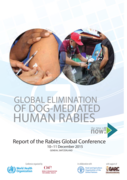
Rabies remains an under-reported neglected zoonosis with a case-fatality rate of almost 100% in humans and animals. Dog-mediated human rabies causes tens of thousands of human deaths annually despite being 100% preventable. More than 95% of human cases are caused by the bite of a rabies-infected dog
...
Following the publication of Guidelines on certification of elimination of human onchocerciasis in 2001 by the World Health Organization (
...
