
Filter
1219
Text search:
prévention
des
infections
Featured
133
312
Language
Document type
632
208
138
79
52
39
35
8
8
7
6
4
3
Countries
54
48
45
43
40
27
27
25
24
18
18
18
16
16
16
16
16
15
14
14
14
14
12
12
11
10
10
9
9
8
8
7
7
6
6
5
5
5
5
5
5
4
4
4
4
4
3
3
3
3
3
3
3
2
2
2
2
2
2
2
2
2
2
2
2
2
2
2
2
2
1
1
1
1
1
1
1
1
1
1
1
1
1
1
1
1
1
Authors & Publishers
Publication Years
Category
433
183
155
103
93
68
16
Toolboxes
138
85
82
77
70
66
51
29
27
24
24
18
15
14
11
10
9
8
5
5
3
2
1
Preventive chemotherapy to control soil-transmitted helminth infections in at-risk population groups
recommended
Treating children infected with intestinal worms is one of the simplest and most cost–effective ways to improve their health.
The recommendations are intended for a wide audience, including policy-makers and their expert advisers as well as technical and programme staff at government institution
...

Biology, Diagnosis and Treatment, Epidemiology and Prevention
Infectious diseases are the leading cause of death globally, particularly among children and young adults. The spread of new pathogens and the threat of antimicrobial resistance pose particular challenges in combating these diseases. Major Infectious Diseases identifies feasible, cost-effective pack
...

This review focusses on the interactions between the etiologic agent of Chagas disease, Trypanosoma cruzi, and its triatomine vector. The flagellate mainly colonizes the intestinal tract of the insect. The effect of triatomines on trypanosomes is indicated by susceptibility and refractoriness phenom
...

This document updates the 2009 ECDC guidance on chlamydia control in Europe. It was developed by a technical expert group which conducted a critical review of the scientific evidence on the epidemiology of chlamydia and the effectiveness of screening programmes.
The aim of this guidance is to suppo
...
ECDC Technical Report
In line with ECDC’s recommendations provided in the ’Risk Assessment of HTLV-1/2 transmission by tissue/cell transplantation’ dated 14 March 2012, this Directive replaces the term ‘incidence’ with ‘prevalence’ in the description of endemic areas of HTLV-1/2 i ...
In line with ECDC’s recommendations provided in the ’Risk Assessment of HTLV-1/2 transmission by tissue/cell transplantation’ dated 14 March 2012, this Directive replaces the term ‘incidence’ with ‘prevalence’ in the description of endemic areas of HTLV-1/2 i ...
ECDC Technical Document
Recommendations of the Healthcare Infection Control Practices Advisory Committee and the HICPAC/SHEA/APIC/IDSA Hand Hygiene Task Force
Biosafety involves the implementation of containment principles, technologies and practices to prevent unintentional exposure to biological agents. Biosecurity involves the protection, control and accountability of biological materials and information related to these materials and dualuse research,
...
This is only the cover of the book. Download the whole Toolkit at: www.cdc.gov/reproductivehealth/Refugee/
Understanding the reproductive health needs of conflict-affected women will enable organizations to implement and enhance programs and services to improve the health of women and their fam
...
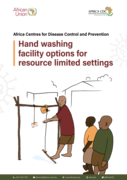
This document provides guidance to AU Member States, states/local bodies, and communities
on how to construct and maintain non-contact hand washing stations like Tippy Taps and other
alternative hand washing stations.
WHO Package of Essential NCD Interventions (PEN)
Accessed March 18,2019
COVID-19 & Community Health Workers
recommended
2-Day Orientation training Orientation Training, 1 Febr. 2021
Community Health Workers (CHWs) are an essential part of the Partnership to Accelerate COVID-19 Testing (PACT) Initiative • Africa CDC set up PACT to drive forward the Africa Union Joint Continental Strategy for COVID-19
Available in
...
Formation d'orientation pendant 2 jours25 Juin 2020
Pour répondre au besoin urgent de lits requis pour traiter les patients atteints d'Ebola, plusieurs établissements ont été reconfigurés pour prendre en charge, isoler et traiter les patients. Nombre d’entre eux ont été construits au sein d’hôpitaux, d’écoles ou de bâtiments existants
...
