Filter
2198
Text search:
drug
users
Featured
194
630
Language
2103
46
42
38
15
12
9
3
3
3
2
2
2
2
1
1
1
1
1
1
1
1
1
1
1
1
1
1
1
1
1
1
1
1
1
1
Document type
1482
253
247
100
51
23
23
10
4
4
1
Countries
131
64
60
55
54
53
52
52
43
39
36
33
32
32
31
31
31
28
25
25
24
24
21
20
17
16
16
14
13
12
11
11
11
11
9
8
7
7
7
6
6
6
5
5
5
5
4
4
4
4
4
3
3
3
3
3
3
3
3
3
3
3
3
3
2
2
2
2
2
2
2
2
2
2
2
2
2
2
1
1
1
1
1
1
1
1
1
1
1
1
1
1
1
1
1
1
1
1
1
1
1
1
1
1
Authors & Publishers
281
153
138
80
70
60
47
40
29
26
22
21
21
20
18
17
16
16
15
14
13
13
13
12
12
11
11
11
10
9
9
9
9
9
8
8
8
8
8
8
8
7
7
7
7
7
7
7
6
6
6
6
6
6
6
6
6
6
6
6
6
6
6
5
5
5
5
5
5
5
5
5
5
5
5
5
5
5
4
4
4
4
4
4
4
4
4
4
4
4
4
4
4
4
4
4
4
3
3
3
3
3
3
3
3
3
3
3
3
3
3
3
3
3
3
3
3
3
3
3
3
3
3
3
3
3
3
3
3
3
3
3
3
3
3
3
3
3
3
3
3
3
3
3
3
3
3
3
3
3
3
3
3
3
3
3
3
3
3
3
3
2
2
2
2
2
2
2
2
2
2
2
2
2
2
2
2
2
2
2
2
2
2
2
2
2
2
2
2
2
2
2
2
2
2
2
2
2
2
2
2
2
2
2
2
2
2
2
2
2
2
2
2
2
2
2
2
2
2
2
2
2
2
2
2
2
2
2
2
2
2
2
2
2
2
2
2
2
2
2
2
2
2
2
2
2
2
2
2
2
2
2
2
2
2
2
2
2
2
2
2
2
2
2
2
2
2
2
2
2
2
2
2
2
2
2
2
2
2
2
2
2
2
2
2
2
2
2
2
2
2
2
2
2
2
2
2
2
2
2
2
2
2
2
2
2
2
2
2
2
2
2
2
2
2
2
2
2
2
2
2
2
1
1
1
1
1
1
1
1
1
1
1
1
1
1
1
1
1
1
1
1
1
1
1
1
1
1
1
1
1
1
1
1
1
1
1
1
1
1
1
1
1
1
1
1
1
1
1
1
1
1
1
1
1
1
1
1
1
1
1
1
1
1
1
1
1
1
1
1
1
1
1
1
1
1
1
1
1
1
1
1
1
1
1
1
1
1
1
1
1
1
1
1
1
1
1
1
1
1
1
1
1
1
1
1
1
1
1
1
1
1
1
1
1
1
1
1
1
1
1
1
1
1
1
1
1
1
1
1
1
1
1
1
1
1
1
1
1
1
1
1
1
1
1
1
1
1
1
1
1
1
1
1
1
1
1
1
1
1
1
1
1
1
1
1
1
1
1
1
1
1
1
1
1
1
1
1
1
1
1
1
1
1
1
1
1
1
1
1
1
1
1
1
1
1
1
1
1
1
1
1
1
1
1
1
1
1
1
1
1
1
1
1
1
1
1
1
1
1
1
1
1
1
1
1
1
1
1
1
1
1
1
1
1
1
1
1
1
1
1
1
1
1
1
1
1
1
1
1
1
1
1
1
1
1
1
1
1
1
1
1
1
1
1
1
1
1
1
1
1
1
1
1
1
1
1
1
1
1
1
1
1
1
1
1
1
1
1
1
1
1
1
1
1
1
1
1
1
1
1
1
1
1
1
1
1
1
1
1
1
1
1
1
1
1
1
1
1
1
1
1
1
1
1
1
1
1
1
1
1
1
1
1
1
1
1
1
1
1
1
1
1
1
1
1
1
1
1
1
1
1
1
1
1
1
1
1
1
1
1
1
1
1
1
1
1
1
1
1
1
1
1
1
1
1
1
1
1
1
1
1
1
1
1
1
1
1
1
1
1
1
1
1
1
1
1
1
1
1
1
1
1
1
1
1
1
1
1
1
1
1
1
1
1
1
1
1
1
1
1
1
1
1
1
1
1
1
1
1
1
1
1
1
1
1
1
1
1
1
1
1
1
1
1
1
1
1
1
1
1
1
1
1
1
1
1
1
1
1
1
1
1
1
1
1
1
1
1
1
1
1
1
1
1
1
1
1
1
1
1
1
1
1
1
1
1
1
1
1
1
1
1
1
1
1
1
1
1
1
1
1
1
1
1
1
1
1
1
1
1
1
1
1
1
1
1
1
1
1
1
1
1
1
1
1
1
1
1
1
1
1
1
1
1
1
1
1
1
1
1
1
1
1
1
1
1
1
1
1
1
1
1
1
1
1
1
1
1
1
1
1
1
1
1
1
1
1
1
1
1
1
1
1
1
1
1
1
1
1
1
1
1
1
1
1
1
1
1
1
1
1
1
1
1
1
1
1
1
1
1
1
1
1
1
1
1
1
1
1
1
1
1
1
1
1
1
1
1
1
1
1
1
1
1
1
1
1
1
1
1
1
1
1
1
1
1
1
1
1
1
1
1
1
1
1
1
1
1
1
1
1
1
1
1
1
1
1
1
1
1
1
1
1
1
1
1
1
1
1
1
1
1
1
1
1
1
1
1
1
1
1
1
1
1
1
1
1
1
1
1
1
1
1
1
1
1
1
1
1
1
1
1
1
1
1
1
1
1
1
1
1
1
1
1
1
1
1
1
1
1
1
1
1
1
1
1
1
1
1
1
1
1
1
1
1
1
1
1
1
1
1
1
1
1
1
1
1
1
1
1
1
1
1
1
1
1
1
1
1
1
1
1
1
1
1
1
1
1
1
1
1
1
1
1
1
1
1
1
1
1
1
1
1
1
1
1
1
1
1
1
1
1
1
1
1
1
1
1
1
1
1
1
1
1
1
1
1
1
1
1
1
1
1
1
1
1
1
1
1
1
1
1
1
1
1
1
1
1
1
1
1
1
1
1
1
1
1
1
1
1
1
1
1
1
1
1
1
1
1
1
1
1
1
1
1
1
1
1
1
1
1
1
1
1
1
1
1
1
1
1
1
1
1
1
1
1
1
1
1
1
1
1
1
1
1
1
1
1
1
1
1
1
1
1
1
1
1
1
1
1
1
1
1
1
1
1
1
1
1
1
1
1
1
1
1
1
1
1
1
1
1
1
1
1
1
1
1
1
1
1
1
1
1
1
1
1
1
1
1
1
1
1
1
1
1
1
1
1
1
1
1
1
1
1
1
1
1
1
1
1
1
1
1
1
1
1
1
1
1
1
1
1
1
1
1
1
1
1
1
1
1
1
1
1
1
1
1
1
1
1
1
1
1
1
1
1
1
1
1
1
1
1
1
1
1
1
1
1
1
1
1
1
1
1
1
1
1
1
1
1
1
1
1
1
1
1
1
1
1
1
1
1
1
1
1
1
1
1
1
1
1
1
1
1
1
1
1
1
1
1
1
1
1
1
1
1
1
1
1
1
1
1
1
1
1
1
1
1
1
1
1
1
1
1
1
1
1
1
1
1
1
1
1
1
1
1
1
1
1
1
1
1
1
1
1
1
1
1
1
1
1
1
1
1
1
1
1
1
1
1
1
1
1
1
1
1
1
1
1
1
1
1
1
1
1
1
1
1
1
1
1
1
1
1
1
1
1
1
1
1
1
1
1
1
1
1
1
1
1
1
1
1
1
1
1
1
1
1
1
1
1
1
1
1
1
1
1
1
1
1
1
1
1
1
1
1
1
1
1
1
1
1
1
1
1
1
1
1
1
1
1
1
1
1
1
1
1
1
1
1
1
1
1
1
1
1
1
1
1
1
1
1
1
1
1
1
1
1
1
1
1
1
1
1
1
1
1
1
1
1
1
1
1
1
1
1
1
1
1
1
1
1
1
1
1
1
1
1
1
1
1
1
1
1
1
1
1
1
1
1
1
1
1
1
1
1
1
1
1
1
1
1
1
1
1
1
1
1
1
1
1
1
1
1
1
1
1
1
1
1
1
1
1
1
1
1
1
1
1
1
1
1
1
1
1
1
1
1
1
1
1
1
1
1
1
1
1
1
1
1
1
1
1
1
1
1
1
1
1
1
1
1
1
1
1
1
1
1
1
1
1
1
1
1
1
1
1
1
1
1
1
1
1
1
1
1
1
1
1
1
1
1
1
1
1
1
1
1
1
1
1
1
1
1
1
1
1
1
1
1
1
1
1
1
1
1
1
1
1
1
1
1
1
1
1
1
1
1
1
1
1
1
1
1
1
1
1
1
1
1
1
1
1
1
1
1
1
1
1
1
1
1
1
1
1
1
1
1
1
1
1
1
1
1
1
1
1
1
1
1
1
1
1
1
1
1
1
1
1
1
1
1
1
1
1
1
1
1
1
1
1
1
1
1
1
1
1
1
1
1
1
1
1
1
1
1
1
1
1
1
1
1
1
1
1
1
1
1
1
1
1
1
1
1
1
1
1
1
1
1
1
1
1
1
1
1
1
1
1
1
1
1
1
1
1
1
1
1
1
1
1
1
1
1
1
1
1
1
1
1
1
1
1
1
1
1
1
1
1
1
1
1
1
1
1
1
1
1
1
1
1
1
1
1
1
1
1
1
1
1
1
1
1
1
1
1
1
1
1
1
1
1
1
1
1
1
1
1
1
1
1
1
1
1
1
1
1
1
1
1
1
1
1
1
1
1
1
1
1
1
1
1
1
1
1
1
1
1
1
1
1
1
1
1
1
1
1
1
1
1
1
1
1
1
1
1
1
1
1
1
1
1
1
1
1
1
1
1
1
1
1
1
1
1
1
1
1
1
1
1
1
1
1
1
1
1
1
1
1
1
1
1
1
1
1
1
1
1
1
1
1
1
1
1
1
1
1
1
1
1
1
1
1
1
1
1
1
1
1
1
1
1
1
1
1
1
1
1
1
1
1
1
1
1
1
1
1
1
1
1
1
1
1
1
1
1
1
1
1
1
1
1
1
1
1
1
1
1
1
1
1
1
1
1
1
1
1
1
1
1
1
1
1
1
1
1
1
1
Publication Years
370
1574
238
15
1
Category
843
171
114
78
61
30
28
1
1
Toolboxes
364
260
202
74
73
60
40
31
31
30
25
23
20
19
19
14
11
9
8
7
6
3
1
1
Providing quality, stigma-free services is essential to equitable health care for all and achieving global HIV goals and broader Sustainable Development Goals related to health. Every person has the right to the highest attainable standard of physical and mental health. Countries have a legal obliga
...
tion to develop and implement legislation and policies that guarantee universal access to quality health services and address the root causes of health disparities, including poverty, stigma and discrimination.
The health sector is uniquely placed to lead in addressing inequity, assuring safe personcentred care for everyone and improving social determinants of health by overcoming taboos and discriminatory or stigmatizing behaviours associated with HIV, viral hepatitis and sexually transmitted infections (STIs). Improving health care quality and reducing stigma work together to enhance health outcomes for people living with HIV. Together, they make health care services more accessible, trustworthy and supportive. This encourages early diagnosis, consistent treatment and improved mental well-being. Thus, people living with HIV are more likely to engage with and benefit from health care services, leading to improved overall health.
more
This UNAIDS 2024 report brings together new data and case studies which demonstrate that the decisions and policy choices taken by world leaders this year will decide the fate of millions of lives and whether the world’s deadliest pandemic is overcome.
The 2023 update of the Global Strategy for Asthma Management and Prevention incorporates new scientific information about asthma based on a review of recent scientific literature by an international panel of experts on the GINA Science Committee. This comprehensive and practical resource about one o
...
f the most common chronic lung diseases worldwide contains extensive citations from the scientific literature and forms the basis for other GINA documents and programs.
more
The pharmacological management of asthma has changed considerably in recent decades, as it has come to be understood that it is a complex, heterogeneous disease with different phenotypes and endotypes. It is now clear that the goal of asthma treatment should be to achieve and maintain control of the
...
disease, as well as to minimize the risks (of exacerbations, disease instability, accelerated loss of lung function, and adverse treatment effects). That requires an approach that is personalized in terms of the pharmacological treatment, patient education, written action plan, training in correct inhaler use, and review of the inhaler technique at each office visit. A panel of 22 pulmonologists was invited to perform a critical review of recent evidence of pharmacological treatment of asthma and to prepare this set of recommendations, a treatment guide tailored to use in Brazil. The topics or questions related to the most significant changes in concepts, and consequently in the management of asthma in clinical practice, were chosen by a panel of experts. To formulate these recommendations, we asked each expert to perform a critical review of a topic or to respond to a question, on the basis of evidence in the literature. In a second phase, three experts discussed and structured all texts submitted by the others. That was followed by a third phase, in which all of the experts reviewed and discussed each recommendation. These recommendations, which are intended for physicians involved in the treatment of asthma, apply to asthma patients of all ages.
more
National action plans on antimicrobial resistance (AMR) often overlook the critical intersection of gender, despite evidence that exposure and susceptibility to infection, health-seeking behaviours, as well as antimicrobial prescribing and use patterns are all influenced by gender.
About one fourth of the world’s population is estimated to have been infected with the tuberculosis (TB) bacilli, and about 5–10% of those infected develop TB disease in their lifetime. The risk for TB disease after infection depends on several factors, the most important being the person’s im
...
munological status. TB preventive treatment (TPT) given to people at highest risk of progressing from TB infection to disease remains a critical element to achieve the global targets of the End TB Strategy, as reiterated by the second UN High Level Meeting on TB in 2023. Delivering TPT effectively and safely necessitates a programmatic approach to implement a comprehensive package of interventions along a cascade of care: identifying individuals at highest risk, screening for TB and ruling out TB disease, testing for TB infection, and choosing the preventive treatment option that is best suited to an individual, managing adverse events, supporting medication adherence and monitoring programmatic performance.
more
The European Respiratory Society (ERS)/American Thoracic Society (ATS) Task Force on severe asthma includes an updated definition of severe asthma, a discussion of severe asthma phenotypes in relation to genetics, natural history, pathobiology and physiology, as well as sections on evaluation and tr
...
eatment of severe asthma where specific recommendations for practice are made. See the unabridged online version of the document for detailed discussion of the definition of severe asthma, phenotypes and recommendations for practice.
more
Uganda is Africa's largest refugee-hosting country and ranks fifth globally. Over the decades, Uganda has hosted refugees from nations including South Sudan, the Democratic Republic of Congo, Eritrea, Somalia, Sudan, Burundi, and Rwanda. As of early 2024, it hosts 1 600 000 refugees, primarily in re
...
fugee settlements in northern and southwestern Uganda, and in Kampala City. Thirteen districts accommodate 94% of these refugees.
The World Health Organization (WHO) and Uganda’s Ministry of Health conducted a joint review mission to provide a comprehensive overview of the health system's response. The aim was to understand service delivery challenges and identify opportunities to further support Uganda in strengthening health system capacity and ensuring continued access to health services for refugees, migrants and host communities.
more
Asthma is a serious global health problem affecting all age groups. Its prevalence is increasing in many countries, espacially among children. Although some countries have seen a decline in hospitalizations and deaths from asthma, asthma still imposes an unacceptable burden on health care systems, a
...
nd on society through loss of productivity in the workplace and, espacially for pediatric asthma, disruption to the family.
more
Bonchial asthma is the most common chronic respiratory disease in the world. In Kenya, it has been estimated that about 7.5% of the Kenyan population, nearly 4 million people, are currently living with asthma. Many cases tend to be underdiagnosed and undertreated which leads to high levels of morbid
...
ity and avoidable deaths. The consequences of poorly controlled asthma, including physical, mental, social, and economic impacts, are magnified in the poor on account of poor access to asthma services and sub-optimal quality of those services. With these guidelines, Kenya's Ministry of Health aims to work towards embedding asthma care in Universal Health Care (UHC) to ensure that quality asthma services are available in primary care settings with
referral networks strengthened for those who may require secondary and tertiary care. These national asthma guidelines will also ensure that treatment for asthma is standardized in both the public and the non-state health care sector.
more
Mpox is an emerging zoonotic disease caused by the mpox virus, a member of the Orthopoxvirus genus closely related to the variola virus that causes smallpox. Mpox was first discovered in 1958 when outbreaks of a pox-like disease occurred in monkeys kept for research. The first human case was recorde
...
d in 1970 in the Democratic Republic of the Congo (DRC) during a period of intensified effort to eliminate smallpox and since then the infection has been reported in a number of African countries. Mpox can spread in humans through close contact, usually skin-to-skin contact, including sexual contact, with an infected person or animal, as well as with materials contaminated with the virus such as clothing, beddings and towels, and respiratory droplets in prolonged face to face contact. People remain infectious from the onset of symptoms until all the lesions have scabbed and healed. The virus may spread from infected animals through handling infected meat or through bites or scratches. Diagnosis is confirmed by polymerase chain reaction (PCR) testing of material from a lesion for the virus’s DNA. Two separate clades of the mpox virus are currently circulating in Africa: Clade I, which includes subclades Ia and Ib, and Clade II, comprising subclades IIa and IIb. Clade Ia and Clade Ib have been associated with ongoing human-to-human transmission and are presently responsible for outbreaks in the Democratic Republic of the Congo (DRC), while Clade Ib is also contributing to outbreaks in Burundi and other countries.
In 2022‒2023 mpox caused a global outbreak in over 110 countries, most of which had no previous history of the disease, primarily driven by human-to-human transmission of clade II through sexual contact. In just over a year, over 90,000 cases and 150 deaths were reported to the WHO. For the second time since 2022, mpox has been declared a global health emergency as the virus spreads rapidly across the African continent. On 13 Aug 2024, Africa CDC declared the ongoing mpox outbreak a Public Health Emergency of Continental Security (PHECS), marking the first such declaration by the agency since its inception in 2017.7 This declaration empowered the Africa CDC to lead and coordinate responses to the mpox outbreak across affected African countries. On August 14, 2024, the WHO declared the resurgence of mpox a Public Health Emergency of International Concern (PHEIC) emphasizing the need for coordinated international response.
As of August 2024, Mpox has expanded beyond its traditional endemic regions, with new cases reported in countries including Sweden, Thailand, the Philippines, and Pakistan. Sweden has confirmed its first case of Clade 1 variant, which has been rapidly spreading in Africa, particularly in DRC. The emergence of this new variant raises concerns about its potential for higher lethality and transmission rates outside Africa.
more
Pneumonia and diarrhoea account for 23% of under-five mortality and were responsible for an estimated 1.17 million deaths in children under five globally. Furthermore, pneumonia and diarrhoea were responsible for 18% of mortality in children 5–9 years of age, resulting in an estimated 86 000 preve
...
ntable deaths globally in 2021. Existing World Health Organization (WHO) guidance on the clinical management of pneumonia and diarrhoea has mainly focused on children less than 5 years of age.
more
WHO MiNDbank is an online platform bringing together country and international resources, covering mental health, substance abuse, disability, general health, human rights and development. It is part of WHO’s QualityRights campaign to end violations against people with mental disabilities. MiNDban
...
k aims to facilitate dialogue, advocacy and research, to promote reform in these areas in line with international human rights and best practice standards.
more
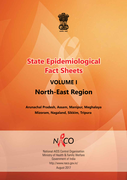
Arunachal Pradesh, Assam, Manipur, Meghalaya, Mizoram, Nagaland, Sikkim, Tripura
This technical document consists of epidemiological profiles (fact-sheets) for States and districts based on information available from multiple data sources including the HIV Sentinel Surveillance (HSS) and the In ... tegrated Biological and Behavioural Surveillance (IBBS). Given the need for focussed prevention efforts in low/high prevalence and vulnerable States/districts, the information presented will be useful for policy makers, program planners at national/State/ district level, researchers, and academicians in identification of areas for priority attention and also to derive meaningful conclusions for programme planning, implementation, monitoring and scale-up. This document will be a quick reference for the HIV/AIDS situation in a State/district, risk and safe behaviour of the high risk groups, their level of knowledge about STIs and HIV/AIDS, experience of violence, HIV testing and ART awareness and exposure to HIV/AIDS prevention. more
This technical document consists of epidemiological profiles (fact-sheets) for States and districts based on information available from multiple data sources including the HIV Sentinel Surveillance (HSS) and the In ... tegrated Biological and Behavioural Surveillance (IBBS). Given the need for focussed prevention efforts in low/high prevalence and vulnerable States/districts, the information presented will be useful for policy makers, program planners at national/State/ district level, researchers, and academicians in identification of areas for priority attention and also to derive meaningful conclusions for programme planning, implementation, monitoring and scale-up. This document will be a quick reference for the HIV/AIDS situation in a State/district, risk and safe behaviour of the high risk groups, their level of knowledge about STIs and HIV/AIDS, experience of violence, HIV testing and ART awareness and exposure to HIV/AIDS prevention. more
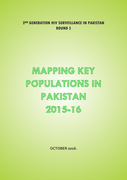
2nd Generation HIV Surveillance in Pakistan, Round 5
The Overall objective of this mapping study was to update population size estimates of selected key populations (PWID, FSWs, MSM & TGs) to create evidence for developing action plans for HIV prevention interventions in Pakistan. A total numbe ... r of 23 cities/towns were selected for Mapping. This included 13 cities in Punjab province, 6 in Sindh Province and 2 cities each in KPK and Baluchistan provinces.
large file: 70,5 MB The preview/download includes only the pages 1 to 23. more
The Overall objective of this mapping study was to update population size estimates of selected key populations (PWID, FSWs, MSM & TGs) to create evidence for developing action plans for HIV prevention interventions in Pakistan. A total numbe ... r of 23 cities/towns were selected for Mapping. This included 13 cities in Punjab province, 6 in Sindh Province and 2 cities each in KPK and Baluchistan provinces.
large file: 70,5 MB The preview/download includes only the pages 1 to 23. more