
Filter
1032
Text search:
global
modelling
study
Featured
91
204
Language
Document type
418
323
152
48
40
22
11
10
5
2
1
Countries
70
32
22
19
18
17
16
15
14
13
12
12
12
12
11
11
10
10
10
9
9
9
8
8
8
8
8
7
7
7
6
6
5
5
5
4
4
4
3
3
3
3
3
3
3
3
3
2
2
2
2
2
2
2
2
2
2
2
2
1
1
1
1
1
1
1
1
1
1
1
1
1
1
1
1
1
1
1
1
1
1
1
1
1
1
Authors & Publishers
Publication Years
Category
237
113
71
35
28
11
10
Toolboxes
158
141
99
99
42
37
31
30
27
26
21
20
19
15
11
10
8
7
7
5
2
2
1
Five years after a global commitment to Fast-Track the HIV response and end AIDS by 2030, the world is off track. A promise to build on the momentum created in the first decade of the twenty-first century by front-loading investment and accelerating
...
Five years after a global commitment to Fast-Track the HIV response and end AIDS by 2030, the world is off track. A promise to build on the momentum created in the first decade of the twenty-first century by front-loading investment and accelerating
...
an approach to optimize the global impact of COVID-19 vaccines, based on public health goals, global and national equity, and vaccine access and coverage scenarios, first issued 20 October 2020, upd
...
The WHO Global strategy on human resources for health: workforce 2030 encourages development partners and global health initiatives to leverage their support to health systems in countries to sustai
...
PLoS Neglected Tropical Diseases https://doi.org/10.1371/journal.pntd.0004762
This study shows the importance of an integrated entomological and medical surveillance for the evaluation of arboviral disease risk, which is a precondition for designi
...
Countries are making progress toward the global goal of 95% of people living with HIV knowing their status by 2025. However, considerable gaps remain in achieving these goals globally. Men in high HIV burden settings and men from key populations in
...
Since 1996, trachoma has been targeted for elimination as a public health problem worldwide. The active trachoma criterion for national elimination as a public health problem is a TF1–9 < 5%, sustained for at least two years in the absence of antibiotic mass drug administration (MDA), in each formerly endemic EU. Using A, F and E, health ministries and their partners have made considerable progress towards achieving this criterion in formerly endemic EUs worldwide. In 2002, an estimated 1517 million people lived in EUs in which EU-wide implementation of the A, F and E components of SAFE were thought to be needed for the purposes of
...
Cardiovascular disease (CVD) is the leading cause of global deaths, with the majority occurring in low- and middle-income countries (LMIC). The primary and secondary prevention of CVD is suboptimal throughout the world, but the evidence-practice gap
...
Joining efforts to control two trelated global epidemics.
2nd Generation HIV Surveillance in Pakistan, Round 5
The Overall objective of this mapping study was to update population size estimates of selected key populations (PWID, FSWs, MSM & TGs) to create evidence for developing action plans for HIV ...
The Overall objective of this mapping study was to update population size estimates of selected key populations (PWID, FSWs, MSM & TGs) to create evidence for developing action plans for HIV ...
In eastern and southern Africa
#EndAdolescentAIDS
July 2018
- A global call to action
- Case studies
- Blogs
- Next steps

The Millennium Development Goals (MDGs) showed
that global commitment and collective action
could significantly reduce the disease burdens of
three deadly communicable diseases: HIV/AIDS,
tuberculosis (TB) and malaria. The MDGs helped
focus eff
...
Infectious diseases continue to impose unpredictable burdens on global health and economies, a subject that requires constant research and updates. In this sense, the objective of the present article was to review studies on the role of wild animals
...
This report provides an overview of air pollution levels and associated health impacts in cities around the world. Since urban areas are often hotspots for poor air quality, city-level data can help to inform targeted efforts to curb urban air pollution and improve public health. This report draws o
...
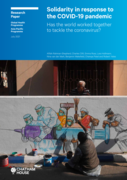
Has the world worked together to tackle the coronavirus? July 2021. This research paper assesses how the global community has responded to calls for greater solidarity in tackling the COVID-19 pandemic, and presents the insights of key stakeholders
...
The WHO End TB Strategy aims to end the global TB epidemic by 2030, in alignment with Goal 3 of the United Nations (UN) Sustainable Development Goals (SDGs). Member States of the World Health Organization (WHO) and the UN committed to ending the TB
...
This fourth progress report November 2020 of the Global HIV Prevention Coalition reviews the progress in the 28 focus countries and complements the three previous progress reports. This report describes key developments in 2019–2020, identifies ch
...
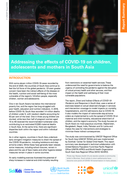
Summary of the main report: Direct and indirect effects of COVID-19 pandemic and response in South Asia .
It uses a series of exercises based on actual observed changes in services and intervention coverage to model impacts on mortality, hospitalizations, and ICU admissions due to COVID-19. It a
...
At a time when the world is reeling from the deepest global disruption and health crisis of a lifetime, this year’s Living Planet
report provides unequivocal and alarming evidence that nature is unraveling and that our planet is flashing red war
...
Minimizing risk of developing antibiotic resistance and aquatic ecotoxicity in the environment resulting from the manufacturing of human antibiotic.
The Standard, facilitated by BSI Standards Limited (BSI), provides clear guidance to manufacturers in the
...
