
Filter
3187
Text search:
outbreak
response
Featured
373
866
Language
2873
153
90
84
73
50
27
21
20
7
6
6
5
4
3
3
3
3
2
2
2
2
2
2
1
1
1
1
1
1
1
1
1
1
1
1
1
1
1
1
1
1
1
1
1
Document type
1390
569
563
200
166
104
89
49
16
15
9
8
4
Countries
204
186
140
115
95
91
76
69
63
57
54
53
53
51
50
49
46
45
45
44
44
43
43
40
37
34
34
32
32
30
28
27
27
25
24
22
21
21
20
20
20
20
18
17
17
17
16
16
16
15
15
14
14
12
12
11
11
11
10
9
9
9
8
8
7
7
7
7
7
7
7
6
6
6
6
6
6
5
5
5
4
4
4
4
4
4
4
4
3
3
3
3
3
3
3
2
2
2
2
2
2
2
2
2
2
2
2
2
2
2
2
1
1
1
1
1
1
1
1
1
1
1
1
1
1
1
1
1
1
1
Authors & Publishers
580
187
100
94
91
75
48
46
45
43
40
35
31
31
23
21
21
19
19
18
18
17
16
15
15
15
15
15
15
14
14
14
14
14
13
13
13
13
12
11
11
11
11
11
10
10
10
9
9
9
9
9
9
9
9
9
9
8
8
8
8
8
8
7
7
7
7
7
7
7
7
7
7
7
6
6
6
6
6
6
6
6
6
6
6
6
6
6
6
6
6
5
5
5
5
5
5
5
5
5
5
5
5
5
5
5
4
4
4
4
4
4
4
4
4
4
4
4
4
4
4
4
4
4
4
4
4
4
4
4
3
3
3
3
3
3
3
3
3
3
3
3
3
3
3
3
3
3
3
3
3
3
3
3
3
3
3
3
3
3
3
3
3
3
3
3
3
3
3
3
3
3
3
3
3
3
3
3
3
3
3
3
3
3
3
2
2
2
2
2
2
2
2
2
2
2
2
2
2
2
2
2
2
2
2
2
2
2
2
2
2
2
2
2
2
2
2
2
2
2
2
2
2
2
2
2
2
2
2
2
2
2
2
2
2
2
2
2
2
2
2
2
2
2
2
2
2
2
2
2
2
2
2
2
2
2
2
2
2
2
2
2
2
2
2
2
2
2
2
2
2
2
2
2
2
2
2
2
2
2
2
2
2
2
2
2
2
2
2
2
2
2
2
2
2
2
2
2
2
2
2
2
2
2
2
2
2
2
2
2
2
2
2
2
2
2
2
2
2
2
2
2
2
2
2
2
2
2
2
2
2
2
2
2
2
2
2
2
1
1
1
1
1
1
1
1
1
1
1
1
1
1
1
1
1
1
1
1
1
1
1
1
1
1
1
1
1
1
1
1
1
1
1
1
1
1
1
1
1
1
1
1
1
1
1
1
1
1
1
1
1
1
1
1
1
1
1
1
1
1
1
1
1
1
1
1
1
1
1
1
1
1
1
1
1
1
1
1
1
1
1
1
1
1
1
1
1
1
1
1
1
1
1
1
1
1
1
1
1
1
1
1
1
1
1
1
1
1
1
1
1
1
1
1
1
1
1
1
1
1
1
1
1
1
1
1
1
1
1
1
1
1
1
1
1
1
1
1
1
1
1
1
1
1
1
1
1
1
1
1
1
1
1
1
1
1
1
1
1
1
1
1
1
1
1
1
1
1
1
1
1
1
1
1
1
1
1
1
1
1
1
1
1
1
1
1
1
1
1
1
1
1
1
1
1
1
1
1
1
1
1
1
1
1
1
1
1
1
1
1
1
1
1
1
1
1
1
1
1
1
1
1
1
1
1
1
1
1
1
1
1
1
1
1
1
1
1
1
1
1
1
1
1
1
1
1
1
1
1
1
1
1
1
1
1
1
1
1
1
1
1
1
1
1
1
1
1
1
1
1
1
1
1
1
1
1
1
1
1
1
1
1
1
1
1
1
1
1
1
1
1
1
1
1
1
1
1
1
1
1
1
1
1
1
1
1
1
1
1
1
1
1
1
1
1
1
1
1
1
1
1
1
1
1
1
1
1
1
1
1
1
1
1
1
1
1
1
1
1
1
1
1
1
1
1
1
1
1
1
1
1
1
1
1
1
1
1
1
1
1
1
1
1
1
1
1
1
1
1
1
1
1
1
1
1
1
1
1
1
1
1
1
1
1
1
1
1
1
1
1
1
1
1
1
1
1
1
1
1
1
1
1
1
1
1
1
1
1
1
1
1
1
1
1
1
1
1
1
1
1
1
1
1
1
1
1
1
1
1
1
1
1
1
1
1
1
1
1
1
1
1
1
1
1
1
1
1
1
1
1
1
1
1
1
1
1
1
1
1
1
1
1
1
1
1
1
1
1
1
1
1
1
1
1
1
1
1
1
1
1
1
1
1
1
1
1
1
1
1
1
1
1
1
1
1
1
1
1
1
1
1
1
1
1
1
1
1
1
1
1
1
1
1
1
1
1
1
1
1
1
1
1
1
1
1
1
1
1
1
1
1
1
1
1
1
1
1
1
1
1
1
1
1
1
1
1
1
1
1
1
1
1
1
1
1
1
1
1
1
1
1
1
1
1
1
1
1
1
1
1
1
1
1
1
1
1
1
1
1
1
1
1
1
1
1
1
1
1
1
1
1
1
1
1
1
1
1
1
1
1
1
1
1
1
1
1
1
1
1
1
1
1
1
1
1
1
1
1
1
1
1
1
1
1
1
1
1
1
1
1
1
1
1
1
1
1
1
1
1
1
1
1
1
1
1
1
1
1
1
1
1
1
1
1
1
1
1
1
1
1
1
1
1
1
1
1
1
1
1
1
1
1
1
1
1
1
1
1
1
1
1
1
1
1
1
1
1
1
1
1
1
1
1
1
1
1
1
1
1
1
1
1
1
1
1
1
1
1
1
1
1
1
1
1
1
1
1
1
1
1
1
1
1
1
1
1
1
1
1
1
1
1
1
1
1
1
1
1
1
1
1
1
1
1
1
1
1
1
1
1
1
1
1
1
1
1
1
1
1
1
1
1
1
1
1
1
1
1
1
1
1
1
1
1
1
1
1
1
1
1
1
1
1
1
1
1
1
1
1
1
1
1
1
1
1
1
1
1
1
1
1
1
1
1
1
1
1
1
1
1
1
1
1
1
1
1
1
1
1
1
1
1
1
1
1
1
1
1
1
1
1
1
1
1
1
1
1
1
1
1
1
1
1
1
1
1
1
1
1
1
1
1
1
1
1
1
1
1
1
1
1
1
1
1
1
1
1
1
1
1
1
1
1
1
1
1
1
1
1
1
1
1
1
1
1
1
1
1
1
1
1
1
1
1
1
1
1
1
1
1
1
1
1
1
1
1
1
1
1
1
1
1
1
1
1
1
1
1
1
1
1
1
1
1
1
1
1
1
1
1
1
1
1
1
1
1
1
1
1
1
1
1
1
1
1
1
1
1
1
1
1
1
1
1
1
1
1
1
1
1
1
1
1
1
1
1
1
1
1
1
1
1
1
1
1
1
1
1
1
1
1
1
1
1
1
1
1
1
1
1
1
1
1
1
1
1
1
1
1
1
1
1
1
1
1
1
1
1
1
1
1
1
1
1
1
1
1
1
1
1
1
1
1
1
1
1
1
1
1
1
1
1
1
1
1
1
1
1
1
1
1
1
1
1
1
1
1
1
1
1
1
1
1
1
1
1
1
1
1
1
1
1
1
1
1
1
1
1
1
1
1
1
1
1
1
1
1
1
1
1
1
1
1
1
1
1
1
1
1
1
1
1
1
1
1
1
1
1
1
1
1
1
1
1
1
1
1
1
1
1
1
1
1
1
1
1
1
1
1
1
1
1
1
1
1
1
1
1
1
1
1
1
1
1
1
1
1
1
1
1
1
1
1
1
1
1
1
1
1
1
1
1
1
1
1
1
1
1
1
1
1
1
1
1
1
1
1
1
1
1
1
1
1
1
1
1
1
1
1
1
1
1
1
1
1
1
1
1
1
1
1
1
1
1
1
1
1
1
1
1
1
1
1
1
1
1
1
1
1
1
1
1
1
1
1
1
1
1
1
1
1
1
1
1
1
1
1
1
1
1
1
1
1
1
1
1
1
1
1
1
1
1
1
1
1
1
1
1
1
1
1
1
1
1
1
1
1
1
1
1
1
1
1
1
1
1
1
1
1
1
1
1
1
1
1
1
1
1
1
1
1
1
1
1
1
1
1
1
1
1
1
1
1
1
1
1
1
1
1
1
1
1
1
1
1
1
1
1
1
1
1
1
1
1
1
1
1
1
1
1
1
1
1
1
1
1
1
1
1
1
1
1
1
1
1
1
1
1
1
1
1
1
1
1
1
1
1
1
1
1
1
1
1
1
1
1
1
1
1
1
1
1
1
1
1
1
1
1
1
1
1
1
1
1
1
1
1
1
1
1
1
1
1
1
1
1
1
1
1
1
1
1
1
1
1
1
1
1
1
1
1
1
1
1
1
1
1
1
1
1
1
1
1
1
1
1
1
1
1
1
1
1
1
1
1
1
1
1
1
1
1
1
1
1
1
1
1
1
1
1
1
1
1
1
1
1
1
1
1
1
1
1
1
1
1
1
1
1
1
1
1
1
1
1
1
1
1
1
1
1
1
1
1
1
1
1
1
1
1
1
1
1
1
1
1
1
1
1
1
1
1
1
1
1
1
1
1
1
1
1
1
1
1
1
1
1
1
1
1
1
1
1
1
1
1
1
1
1
1
1
1
1
1
1
1
1
1
1
1
1
1
1
1
1
1
1
1
1
1
1
1
1
1
1
1
1
1
1
1
1
1
1
1
1
1
1
1
1
1
1
1
1
1
1
1
1
1
1
1
1
1
1
1
1
1
1
1
1
1
1
1
1
1
1
1
1
1
1
1
1
1
1
1
1
1
1
1
1
1
1
1
1
1
1
1
1
1
1
1
1
1
1
1
1
1
1
1
1
1
1
1
1
1
1
1
1
1
1
1
1
1
1
1
1
1
1
1
1
1
1
1
1
1
1
1
1
1
1
1
1
1
1
1
1
Publication Years
1
1493
1515
161
16
1
Category
1108
189
135
133
75
45
39
3
1
1
Toolboxes
875
423
311
137
99
80
74
73
72
64
62
59
59
55
53
44
37
37
21
17
12
10
3
2
2
This I-Kit provides essential information and tools for responding to an outbreak using an SBCC approach. It presents a series of nine units, each accompanied by exercise worksheets to help link the SBCC theory to practice.
The worksheets in each
...
section are typically followed by a completed example. The completed examples will likely include information about an emergency that, during an actual event, might not be immediately available. This was done to illustrate the full range of information to inform a strategic communication response.
more

At the end of this course, you should be able to:
- Draft an outbreak management plan for managing COVID-19 cases and outbreaks onboard ships;
- Manage an outbreak of COVID-19 disease on board a s
...
hip;
- Perform follow-up epidemiological and environmental investigation.
Target audience:
- National IHR Focal Points
- Port health authorities (PHAs) and local, provincial, and national health surveillance and response systems
- Ship operators and port operators
more
The Nigeria Centre for Disease Control (NCDC) declared a Yellow Fever (YF) outbreak and activated a multi-sectoral Emergency Operations Centre for coordination of Yellow Fever response on 12 Novembe
...
r 2020. The outbreak, which mainly affected three states of Delta, Enugu and Bauchi, already recorded a total of 222 suspected cases 19 confirmed cases and 76 deaths between 1 and 11 November 2020.
more
The purpose of this guide is to provide practical advice for health staff undertaking infectious disease preparedness and response activities to ensure that access to safe abortion care (SAC) is maintained when an infectious disease
...
outbreak occurs. It is an operational guide which can serve to support health actors to maintain SAC services during outbreaks and ensure that necessary SAC considerations are integrated within outbreak responses; it is not a clinical guide. The locational focus of this document is humanitarian and fragile settings; however, recommendations may apply to infectious disease outbreaks in all low-resource populations. This guide is intended to complement Sexual and Reproductive Health and Rights During Infectious Disease Outbreaks: Operational Guidance for Humanitarian and Fragile Settings.
more
Guidance on temporary malaria control measures in Ebola-affected countries
World Health Organization
(2014)
Malaria is a prevalent cause of febrile illnesses in areas with high transmission, and its clinical presentation overlaps with initial signs of Ebola disease. For this reason, the effectiveness of the Ebola response in Guinea, Liberia and Sierra Leo
...
ne can be optimized through the deployment of targeted measures to reduce the number of fever cases due to malaria
WHO recommends specific adaptations in the diagnosis of malaria and in LLIN distribution in countries heavily affected by the Ebola outbreak and mass drug administration using artemisinin-based combination therapies (ACTs) in areas where transmission of both Ebola and malaria is high and access to malaria treatment is very low.
more
Cholera kits 2020
recommended
For several years, agencies supporting preparedness and response to cholera outbreaks have supplied medicines and medical devices through the Interagency Diarrhoeal Disease Kits (IDDK).
In an effort to better align the presentation and content of
...
the kits to field needs, the composition of the cholera kits has been reviewed by WHO and its partners in 2015 and again in 2020. The content of all modules have been slightly revised with no changes except for the cholera laboratory check list.
The revised cholera kits 2020 are designed to help prepare for a potential cholera outbreak and to support the first month of the initial response for 100 cases. The overall package consists of six different kits, each divided in several modules.
more
COVID-19 Environmental Health Guidelines
Nation Institute for Communicable Diseases, South Africa
Department: Health Republic of South Africa
(2020)
C2
This document aims to guide Environmental Health Services (EHS) on key roles related to the management of the outbreak.
This guide should be read in conjunction with the guideline for case finding, diagnosis, management and public health
...
response in South africa and the standard operating procedures on Novel Corona Virus -19 (COVID-19).
more
This research was conducted in March and April 2020 to explore children and young people’s reflections and perceptions on the COVID-19 outbreak. This study was organised in response to the young p
...
eople’s continued child activism in the face of personal challenges.
more
Ebola virus disease preparedness strengthening team Cameroon Country Visit 10 to 14 November
World Health Organization
(2014)
The immediate objective of the country visit to Cameroon was to ensure that the country is as operationally ready as possible to effectively and safely detect, investigate and report potential Ebola virus disease cases and to mount an effective response
...
that will prevent a larger outbreak. After technical working group meetings, field visits, a “table-top” exercise and a hospital-based simulation exercises were undertaken.
Key strengths and weaknesses were identified, and the following areas for improvement were proposed to the Ministry of Health: coordination, surveillance, contact tracing, infection prevention and control, rapid response teams, case management, social mobilization, laboratory, points of entry, budget, logistics.
more

The immediate objective of the country visit to Senegal was to build upon the public health preparedness already in place and to ensure that systems are available to investigate and report potential EVD cases and to mount an effective response to pr
...
event a larger outbreak. The joint team for strengthening preparedness for EVD was composed of representatives of Senegal’s Ministry of Health, WHO, CDC, the United Nations Office for Coordination of Humanitarian Affairs, the European Centres for Disease Prevention and Control, the Erasmus Medical Centre, Netherlands, and John Hopkins University, USA.
more

Ebola virus disease preparedness strengthening team Ghana country visit 10–15 Novmeber 2014
World Health Organization
(2014)
The preparedness strengthening team deployed to Ghana focused on specific objectives in order to assist the country in becoming as operationally prepared as possible to detect, investigate and report potential EVD cases effectively and safely and to mount an effective
...
response to prevent a larger outbreak. To accomplish this goal, the team conducted “scoping” activities, stakeholder meetings, site visits and a “table-top” simulation exercise to determine what systems were in place and what aspects of preparedness could be strengthened.
It is organized in 10 components of the WHO consolidated checklist for EVD preparedness: 1) planning and coordination; 2) epidemiological and laboratory surveillance; 3) rapid response teams; 4) contact tracing; 5) points of entry; 6) laboratory; 7) case management; 8) infection prevention and control; 9) social mobilization and risk communication; 10) budget.
more
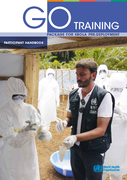
GO pre-deployment training: participant handbook
recommended
This is a pre-deployment training, tailored specially to the Ebola outbreak in West Africa, offered to WHO personnel, consultants, and key partners. The material covered in modules 1-4 is applicable and useful to frontline
...
response workers, national and international. Only Module 5, which focuses on operational aspects - the code of conduct for international civil servants and human resources arrangements for WHO deployees, are specifically geared to all internationally recruited personnel and to WHO deployees respectively
more
The paper sets out the specific communication challenge posed by Ebola and why it was so difficult to get to grips with this in the early months of the outbreak. It thendocuments when the health communication
...
response became more useful and explores what that tells us about effective media and communication. Finally, it offers recommendations to ensure that media and communication are used to their full potential during other disease outbreaks and humanitarian crisis
more
In 2016 WHO introduced the Cholera Kits. These kits replace the Interagency Diarrhoeal Disease Kit (IDDK) which had been used for many years. The Cholera Kit is designed to be flexible and adaptable for preparedness and outbreak
...
response in different contexts. The overall Cholera Kit is made up of an Investigation Kit, Laboratory materials, 3 Treatment Kits (community, periphery and central) and a Hardware Kit. The Treatment and Hardware Kits are each composed of individual modules. Each of the kits and modules can be ordered independently based on field need. To support orders, a Cholera Kit Calculation Tool was developed.
The information note, packing lists and the Kit Calculation Tool are all available from the WHO website at: http://www.who.int/cholera/kit/en/
more
In March 2020 the IASC Reference Group on Mental Health and Psychosocial Support uniting 57 humanitarian organizations as member issued the Interim Briefing Note Addressing Mental Health and Psychosocial Aspects of COVID-19 Outbreak. This document h
...
as proven to be very useful in the response and has till now been translated in 24 languages. It covers a set of recommended activities as well as messages for different target groups.
The current document is an annex to the Interim Briefing Note and is meant to support the MHPSS operational response within the various sectors of humanitarian work. Approaches and interventions to MHPSS are not confined to one sector, but need to be integrated within many existing sectors and clusters.This document contains a wealth of operational information and practical approaches that can be used for humanitarian programming in health, SGBV, community-based protection, nutrition, camp management and camp coordination.
more
Representative, quality, timely and continuous genetic surveillance of SARS-CoV-2 is critical to the COVID-19 outbreak response. This document provides practical guidance to Global Influenza Surveil
...
lance and Response System (GISRS) laboratories and other relevant national laboratories to move beyond virus detection to genomic sequencing of SARS-CoV-2 PCR positive materials obtained from sentinel surveillance of influenza-like illness (ILI), acute respiratory infection (ARI) and severe acute respiratory infection (SARI). It contains considerations on sample selection for sequencing, numbers of viruses to be sequenced, metadata and timeliness for sharing genetic sequence data (GSD) and opportunities for technical support.
more
COVID-19: occupational health and safety for health workers: interim guidance, Interim guidance 2 February 2021
Health workers are at the front line of the COVID-19 outbreak response and as such a
...
re exposed to different hazards that put them at risk. Occupational hazards include exposure to SARS-CoV-2 and other pathogens, violence, harassment, stigma, discrimination, heavy workload and prolonged use of personal protective equipment (PPE). This document provides specific measures to protect occupational health and safety of health workers and highlights the duties, rights and responsibilities for health and safety at work in the context of COVID-19.
more
To guide One Health capacity building efforts in the Republic of Guinea in the wake of the 2014–2016 Ebola virus disease (EVD) outbreak, we sought to identify and assess the existing systems and structures for zoonotic disease detection and contro
...
l. We partnered with the government ministries responsible for human, animal, and environmental health to identify a list of zoonotic diseases – rabies, anthrax, brucellosis, viral hemorrhagic fevers, trypanosomiasis and highly pathogenic avian influenza – as the country's top priorities. We used each priority disease as a case study to identify existing processes for prevention, surveillance, diagnosis, laboratory confirmation, reporting and response across the three ministries. Results were used to produce disease-specific systems “maps” emphasizing linkages across the systems, as well as opportunities for improvement. We identified brucellosis as a particularly neglected condition. Past efforts to build avian influenza capabilities, which had degraded substantially in less than a decade, highlighted the challenge of sustainability. We observed a keen interest across sectors to reinvigorate national rabies control, and given the regional and global support for One Health approaches to rabies elimination, rabies could serve as an ideal disease to test incipient One Health coordination mechanisms and procedures. Overall, we identified five major categories of gaps and challenges: (1) Coordination; (2) Training; (3) Infrastructure; (4) Public Awareness; and (5) Research. We developed and prioritized recommendations to address the gaps, estimated the level of resource investment needed, and estimated a timeline for implementation. These prioritized recommendations can be used by the Government of Guinea to plan strategically for future One Health efforts, ideally under the auspices of the national One Health Platform. This work demonstrates an effective methodology for mapping systems and structures for zoonotic diseases, and the benefit of conducting a baseline review of systemic capabilities prior to embarking on capacity building efforts.
more
The strengthened plan aims to achieve and sustain a polio-free world through a focus on implementation and accountability. Emphasis will be on cutting outbreak response times; increasing vaccine de
...
mand; transforming campaign effectiveness; working systematically through integration; increasing access in inaccessible areas; transitioning towards government ownership; and improving decision-making and accountability.
more
The strengthened plan aims to achieve and sustain a polio-free world through a focus on implementation and accountability. Emphasis will be on cutting outbreak response times; increasing vaccine de
...
mand; transforming campaign effectiveness; working systematically through integration; increasing access in inaccessible areas; transitioning towards government ownership; and improving decision-making and accountability.
more
