Filter
331
Text search:
National
Drug
Authority,
Uganda
Featured
Recommendations
26
New Publications
112
Language
Document type
No document type
195
Studies & Reports
72
Guidelines
32
Strategic & Response Plan
14
Manuals
9
Fact sheets
5
Training Material
2
Situation Updates
2
Countries / Regions
Uganda
67
Kenya
26
Ethiopia
12
Tanzania
12
Malawi
11
Nigeria
9
Zambia
9
Global
9
Liberia
8
Congo, Democratic Republic of
8
Rwanda
8
Africa
8
Sierra Leone
7
Ghana
7
South Africa
7
Namibia
4
Guinea
3
Zimbabwe
3
Senegal
2
Pakistan
2
Jordan
2
Syria
2
Sudan
2
Eswatini/ Swaziland
2
Iran
2
Morocco
1
Saudi Arabia
1
Cameroon
1
Haiti
1
Philippines
1
India
1
Somalia
1
South Sudan
1
Iraq
1
Germany
1
Lebanon
1
Cambodia
1
Thailand
1
Benin
1
Central African Republic
1
Botswana
1
Greece
1
Lesotho
1
Mexico
1
Sri Lanka
1
West and Central Africa
1
Latin America and the Carribbean
1
Western and Central Europe
1
Venezuela
1
Albania
1
Laos
1
Georgia
1
Gabon
1
Tunisia
1
Authors & Publishers
Publication Years
Category
Countries
150
Clinical Guidelines
29
Public Health
16
Women & Child Health
13
Pharmacy & Technologies
8
Key Resources
6
Capacity Building
2
Toolboxes
HIV
43
AMR
33
Mental Health
23
Pharmacy
20
TB
16
NTDs
12
Ebola
9
Refugee
9
Rapid Response
8
COVID-19
6
Caregiver
6
Planetary Health
5
NCDs
5
Disability
4
Conflict
4
Global Health Education
3
Zika
2
Health Financing Toolbox
2
Cholera
1
Natural Hazards
1
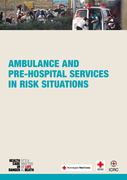
This report sets out ways to make pre-hospital care and ambulance services operating in areas of armed violence safer. Written by the Norwegian Red Cross with support from the ICRC and the Mexican Red Cross, the report summarizes field experience in over 20 countries.

Networking for Policy Change: TB/HIV Participant’s Guide
WHO/HTM/TB/2007.384b
“TB is too often a death sentence for people with AIDS. It does not have to be this
way.”
-Nelson Mandela, International conference on HIV and AIDS, Bangkok, Thailand, July 2004.
Bulletin of the World Health Organization 2007;85:637–643
Une traduction en français de ce résumé figure à la fin de l’article.
Al final del artículo se facilita una traducción al español.
الترجمة العربية لهذه الخلاصة في نهاية النص الكامل ل
...


Risk Communication and Community Engagement (RCCE) is an essential part of any disease outbreak response. Risk communication in the context of an Ebola outbreak refers to real time exchange of information, opinion and advice between frontline responders and people who are faced with the threat of Eb
...
Accessed: 17.11.2019
Consolidated guidelines on the use of antiretroviral drugs for treating and preventing HIV infection
Accessed: 26.02.2020
Preferred product characteristics” (PPCs) are key tools to incentivize and guide the development of urgently needed health products. The PPC published here describes the characteristics of new types of insecticide-treated nets (ITNs) to control malaria transmission in areas with insecticide-resist
...
The Kenyan Health Sector has been playing a critical role in
providing health care services in response to the population
needs in line with the Kenya Health Policy, 2014-2030’s goal
of attaining the highest possible health standards in a manner
responsive to the population needs.
On 15–16 December 2020, WHO and the Medicines for Malaria Venture co-convened a technical consultation to consider the preferred product characteristics (PPCs) for drugs used in malaria chemoprevention. The main goal of the technical consultation was to agree on the most important PPCs for drugs t
...
This fourth annual report monitors global progress towards the 2023 target for global elimination of industrially produced trans-fatty acids (TFA), highlighting achievements during the past year (October 2021 – September 2022). Countries are responding to the World Health Organization (WHO) call t
...
This fourth annual report monitors global progress towards the 2023 target for global elimination of industrially produced trans-fatty acids (TFA), highlighting achievements during the past year (October 2021 – September 2022). Countries are responding to the World Health Organization (WHO) call t
...