
Filter
310
Text search:
National
AIDS
Council,
Zimbabwe
Featured
Recommendations
19
New Publications
70
Language
Document type
No document type
226
Studies & Reports
41
Guidelines
27
Manuals
7
Strategic & Response Plan
5
Situation Updates
4
Countries / Regions
Zimbabwe
36
Zambia
20
South Africa
20
Africa
12
Malawi
11
Uganda
10
Kenya
10
Botswana
10
Lesotho
8
Mozambique
7
Ethiopia
6
Tanzania
6
Namibia
6
Eswatini/ Swaziland
6
Global
5
Nigeria
4
India
4
East and Southern Africa
4
Congo, Democratic Republic of
3
Ghana
3
Russia
3
Guinea
2
Sierra Leone
2
Liberia
2
Senegal
2
Rwanda
2
Ukraine
2
Southern Africa
2
Mali
1
Cameroon
1
Haiti
1
Nepal
1
Pakistan
1
South Sudan
1
Cambodia
1
Indonesia
1
Bangladesh
1
Benin
1
Central African Republic
1
Peru
1
Angola
1
Myanmar / Burma
1
West and Central Africa
1
Middle East and North Africa
1
South–East Asia Region
1
Western and Central Europe
1
Eastern Europe
1
Authors & Publishers
Publication Years
Category
Countries
115
Clinical Guidelines
26
Public Health
20
Women & Child Health
12
Key Resources
7
Pharmacy & Technologies
3
Capacity Building
1
Toolboxes
HIV
94
Disability
25
TB
15
Mental Health
11
COVID-19
8
AMR
7
Caregiver
6
Global Health Education
5
NTDs
5
Planetary Health
4
Natural Hazards
3
Pharmacy
3
Refugee
2
Health Financing Toolbox
2
Cholera
1
Conflict
1
Rapid Response
1

Technical Brief
Technical Brief
Damon Barrett, Gonçalo Figueiredo Augusto, Martiani Oktavia, Jeanette Olsson, Mira Schneiders and Kate Welch provided background papers and literature reviews which informed this technical series.
Compendium of Case Studies
The APCA Atlas provides the most up-to-date information of palliative care development in nearly all countries in Africa, using indicators derived, rated, and chosen by in-country African experts followed by a thorough Delphi consensus process with a panel of international experts on palliative care
...
Disabled people in developing countries are the poorest of the poor: if we are serious about tackling extreme poverty, our development work has to target them. The post-2015 development framework offers hope that disabled people will finally get the prominence they deserve on the global development
...
This guide can inform any partner that manages or supports public health supply chains. Ministries of health, technical assistance partners, or non-governmental organization (NGO) operating distribution systems can all benefit from conducting a costing exercise and can use the material presented in
...
This document is part of the process for improving the quality of care in family planning. Medical eligibility criteria for contraceptive use (MEC), the first edition of which was published in 1996, prsents current World Health Organization (WHO) guidance on the safety of various contraceptive e-
m
...
The new WHO guidelines recommend that people living with HIV be started on antiretrovirals (ARVs) as soon as possible after being diagnosed. Currently, many people living with the virus globally must wait until their CD4 counts fall to 500 to start treatment. According to the WHO, the move to early
...
This book provides basic information to help women with disabilities stay healthy, and will also help those who assist women with disabilities to provide good care. You can help us improve this health guide. So, if you are a woman with a disability, a caregiver, or anyone with ideas or suggestions a
...
Towards Malaria Elimination
Hindawi Publishing Corporation
Tuberculosis Research and Treatment
Volume 2015, Article ID 752709, 7 pages
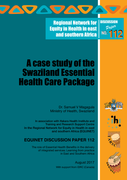
Regional Network for Equity in Health in east and southern Africa (EQUINET): Disussion Paper 112
The Essential Health Benefit (EHB) is known as Essential Health Care Package (EHCP) in Swaziland. This desk review provides evidence on the experience of EHCPs in Swaziland and includes available po ...
The Essential Health Benefit (EHB) is known as Essential Health Care Package (EHCP) in Swaziland. This desk review provides evidence on the experience of EHCPs in Swaziland and includes available po ...

Looking forward, the 2019-2020 Regional Refugee Response Plan (RRRP) for the DRC situation aims at addressing the needs of new arrivals of Congolese refugees in the region, and those in protracted situations. By supporting livelihoods opportunities and through a resilience-based approach, refugees w
...
