
Filter
86
Text search:
poisonings
Featured
8
19
Language
Document type
39
16
14
6
4
3
1
Countries
10
6
3
2
2
2
2
1
1
1
1
1
1
1
1
1
1
1
1
1
1
1
Authors & Publishers
Publication Years
Category
17
7
6
4
2
Toolboxes
20
10
10
9
6
2
2
2
1
1
1
1
1
1

Every year, around 830 000 children die from unintentional or "accidental" injuries. The vast majority of these injuries occur in low-income and middle-income countries. However, dozens of prevention strategies and programmes exist. If they were integrated into other child survival programmes and im
...

Website last accessed on 01.07.2023
Snakebite envenoming - WHO official website

Website last accessed ob 01.07.2023
Snakebite envenoming - WHO official website

Website last accessed ob 01.07.2023
Snakebite envenoming - WHO official website

Website last accessed on 01.07.2023
Snakebite envenoming - WHO official website

Website last accessed on 01.07.2023
Snakebite envenoming - WHO official website

Website last accessed on 01.07.2023
Snakebite envenoming - WHO official website
An update from the EU Early Warning System
Perspectives on Drugs
The WHO Global Health Estimates show that nearly half a million deaths (493 471) occurred in the WHO European Region due to violence and injuries in 2016. This represents a decline of 29% from 2000. Injuries account for 5.3% of all deaths and 9.6 of all years of life lost. They are a leading cause o
...
This update of the Guidelines for poison control, entitled Guidelines for establishing a poison centre, reflects the development of the role of poison centres in public health and the sound management of chemicals, described in section 1, and the opportunities provided by new technology. Assessments
...
WHO Pharmacovigilance indicators: a practical manual for the assessment of pharmacovigilance systems
This manual provides a practical method for determining the pharmacovigilance indices. It is designed to be simple and can be understood by any worker in pharmacovigilance without formal training in monitoring and evaluation. Pharmacovigilance as a medical discipline is crucial in preventing medicin
...
In 2015, 5.9 million children under age five died (1). The major causes of child deaths globally are pneumonia, prematurity, intrapartum-related complications, neonatal sepsis, congenital anomalies, diarrhoea, injuries and malaria (2). Most of these diseases and conditions are at least partially cau
...
This new publication presents the continuing and emerging challenges to children’s environmental health.
Strategic Overview
Accessed: 28.03.2019
Clean and sustainable household energy and appliances, for cooking, heating and lighting can improve health, increase productivity, reduce poverty and protect the environment while addressing air pollution.
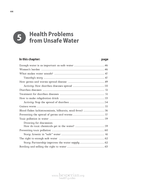
Chapter 5: A Community Guide to Environmental Health
