
Filter
568
Text search:
fetal
assessment
Featured
60
161
Language
Document type
337
103
59
31
15
12
7
1
1
1
1
Countries
38
26
15
14
14
13
11
9
9
8
8
8
7
7
7
6
6
5
5
5
4
4
4
4
4
3
3
2
2
2
2
2
2
2
1
1
1
1
1
1
1
1
1
1
1
1
1
1
1
1
1
1
1
1
1
1
Authors & Publishers
Publication Years
Category
193
114
106
30
19
11
5
Toolboxes
47
35
29
28
25
21
19
11
10
8
7
7
6
6
5
5
3
2
2
2
This recommendation is an update of one of the 49 recommendations that were published in the WHO recommendations on antenatal care for a positive pregnancy experience. The recommendation was developed initially using the standardized operating procedures described in the WHO handbook for guideline d
...
Fetal alcohol spectrum disorders (FASD) represent a range of physical, mental, and behavioral disabilities caused by alcohol use during pregnancy, or prenatal alcohol exposure (PAE). FASDs are considered to be one of the leading preventable causes o
...
Clinical Guideline

In 2014, the Ministry of Health (MOH) in Malawi conducted a nationwide assessment of emergency obstetric and newborn care (EmONC) services. This cross-sectional facility-based survey used 10 data collection modules. Data collection began on 23rd Sep
...
This Rapid Advice Guideline updates the Interim Guidance on the “Assessment of infants with microcephaly in the context of Zika virus” published in February 2016 (WHO/ZIKV/MOC/16.3). The recommendations provides guidance on the screening, clinic
...
Updated May 2021
Policy brief based on the 2007 Rwanda Service Provision Assessment (RSPA) survey. The 2007 RSPA survey describes how the formal health sector in Rwanda provides services for family planning, maternal health, child health, malaria, HIV/AIDS, and othe
...
The aim of this document is to provide interim guidance for interventions to reduce the risk of maternal Zika virus infection and to manage potential complications during pregnancy. This guidance is based on the best available research evidence and covers areas prioritized by an international, multi
...
Methodological field approaches for scientists with a basic background in entomology to prepare and implement a yellow fever entomological assessment during outbreaks
4th edition. A manual for clinics, community health centers and district hospitals

Cases of monkeypox (MPX) acquired in the EU have recently been reported in nine EU Member States (Austria, Belgium, France, Germany, Italy, Portugal, Spain, Sweden, and the Netherlands).
Monkeypox (MPX) does not spread easily between people. Human-to-human transmission occurs through close contact
...
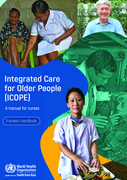
This manual will aid in building the capacity of nurses with clinical knowledge of the unique needs, complex health problems, common geriatric syndromes, and principles of care of older people. It will also enable them to acquire the skills necessary to perform an in-depth multidimensional geriatric
...
The objective of the 2022 Compendium is to compile and highlight emerging innovative health technologies for low-resource settings. It presents a snapshot of technologies that are solutions to an unmet medical/health technology need or are likely to improve health outcomes and the quality of life. H
...
Conflict and Health 2015, 9:8 doi:10.1186/s13031-015-0035-8
