
Filter
924
Text search:
HAT
Featured
94
209
Language
Document type
419
168
113
63
48
40
18
15
15
10
8
6
1
Countries
384
24
23
22
11
10
8
8
8
7
6
6
5
5
5
5
4
4
4
4
4
3
3
3
3
3
3
2
2
2
2
2
2
2
2
2
2
2
2
2
2
2
2
2
2
1
1
1
1
1
1
1
1
1
1
1
1
1
1
1
1
1
1
1
1
1
1
1
1
1
1
1
1
1
1
1
1
Authors & Publishers
Publication Years
Category
167
35
31
22
21
11
1
1
Toolboxes
376
76
72
68
59
30
22
17
16
14
12
10
10
9
8
8
4
3
3
2
1
1
Since 2000, concerted efforts by national programmes, supported by public–private partnerships, nongovernmental organizations, donors and academia under the auspices and coordination of the World Health Organization (WHO), have produced important achievements in the control of human African trypan
...

A clear understanding of the knowledge, attitudes and practices (KAP) of a particular community is necessary in order to improve control of human African trypanosomiasis (HAT).New screening and diagnostic tools and strategies were introduced into So
...
Over the past twenty years, huge efforts made by a broad coalition of stakeholders curbed the last epidemic and brought the disease to the brink of elimination. In this paper, the latest figures on disease occurrence, geographical distribution and control activities are presented. Strong evidence in
...
The epidemiology of the disease is mediated by the interaction of the parasite (trypanosome) with the vectors (tsetse flies), as well as with the human and animal hosts within a particular environment. Related to these interactions, the disease is confined in spatially limited areas called “fociâ€
...
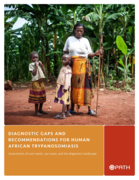
This analysis focused on the chronic form of HAT caused by T. b. gambiense, as it contributes to the majority of disease burden. Information from the literature review,
product development landscape, and stakeholder interviews was compiled to:
-
...
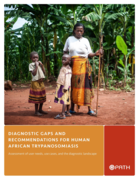
In support of the London Declaration goals, PATH aims to catalyze engagement of the diagnostics industry and product development efforts. As part of this work, PATH conducted a diagnostic landscape analysis to identify gaps and evaluated current and nascent
...
This document focuses on the management of patients affected by gambiense HAT and
constitutes an update to the WHO therapeutic guidance issued in 2013. The main changes in recommendations concern the criteria and methods for deciding the treatment
...
Sleeping sickness is controlled by case detection and treatment but this often only reaches less than 75% of the population. Vector control is capable of completely interrupting HAT transmission but is not used because of expense. We conducted a ful
...

FIND and Standard Diagnostics (SD) have developed a lateral flow rapid diagnostic test (RDT) to screen for
T.b. gambiense HAT that is cheap and easy to use. The tests are packed individually and are stable at 40°C for
up to 25 months; they are pe
...
At the forefront of DNDi’s efforts to develop new treatments is the need to understand the realities and treatment needs of patients and health care staff in the field. The ultimate goal for human African trypanosomiasis (HAT) is a truly simplifie
...
WHO convened the fifth stakeholders meeting on the elimination of HAT due to infection with Trypanosoma brucei gambiense (g-HAT) and Trypanosoma brucei rhodesiense (r-
...
A wide spectrum of disease severity has been described for Human African Trypanosomiasis (HAT) due to
Trypanosoma brucei rhodesiense (T.b. rhodesiense), ranging from chronic disease patterns in southern countries of East Africa to an increase in v
...

This was a Phase 3, multi-center, randomized, open-label, parallel-group, active control study where 273 male and female patients with first stage Trypanosoma brucei gambiense HAT were treated at six sites: one trypanosomiasis reference center in An
...
Human African trypanosomiasis (HAT) has been an alarming global public health issue. The disease affects mainly poor and marginalized people in low-resource settings and is caused by two subspecies of haemoflagellate parasite, Trypanosoma brucei and
...
Helping Adolescents Thrive (Aider les adolescents à s’épanouir – HAT) est une initiative conjointe OMS-UNICEF visant à renforcer les programmes et les politiques en faveur des adolescents, afin de promouvoir une santé mentale positive, de pr
...

Full Perscribing information on Fexinidazole Tablet for oral use
INDICATIONS AND USAGE
Fexinidazole Tablets are indicated for the treatment of both the first-stage (hemolymphatic) and second-stage (meningoencephalitic) human African trypanosomiasis (HAT
...
Human African trypanosomiasis (HAT) is a lethal neglected tropical disease (NTD) transmitted by the bite of infected tsetse flies. The disease is also known as “sleeping sickness”. During the 20th century it caused enormous suffering in the ende
...
تم إعداد هذه الوثيقة التوجيهية، “مجموعة أدوات مساعدة
البرمجة المتعلقة بتعزيز يعلى الازدهار”، لتحس يالمراهق
ولدعم تنفيذ المبادئ يووقاية الصحة النفسية للمراهق
اÙ
...
Die Geschichte "Hat Corona eine Krone auf?“ eignet sich zum Vorlesen und Bearbeiten für ca 4 – 11jährige Kinder.
Arsenical monotherapies were previously very successful for treating human African trypanosomiasis (HAT).
Melarsoprol resistance emerged as early as the 1970s and was widespread by the late 1990s.
Melarsoprol resistance represents the only example
...
