
Filter
36
Breadcrumb:
IFRC
Featured
16
2
Language
Document type
9
7
7
3
3
3
3
1
Countries
3
2
2
2
2
2
2
2
1
1
1
1
1
1
1
1
1
1
1
1
1
1
1
1
Authors & Publishers
Publication Years
Category
7
4
3
2
2
2
2
1
1
1
Toolboxes
7
6
5
5
4
4
4
4
3
3
3
3
3
3
3
3
3
3
2
2
2
1
1
1
1
1
1
1
1
1
1
1
1
1
1
1
1
1
1
1
1
1
1
1
1
1
1
1
El estigma social asociado a COVID-19
recommended
Una guía para prevenir y abordar el estigma social
Social stigma in the context of health is the negative association between a person or group of people who share certain characteristics and a specific disease. In an outbreak, this may mean people are labelled, stereotyped, discriminated against,
...
Stigmatisation sociale associée au COVID-19
recommended
Un guide pour prévenir et combattre la stigmatisation sociale
Dokumen ini menyarankan tindakan untuk mengurangi stigma sosial yang dialami oleh beberapa orang selama wabah penyakit.
Social stigma in the context of health is the negative association between a person or group of people who share certain characteristics and a specific disease. In an outbreak, th
...
Estigma Social associado à COVID-19
recommended
Um guia para prevenir e combater o estigma social
With Safety Tips for Conducting Community Meetings
Updated July 2020
This document includes key Risk Communication and Community Engagement (RCCE) considerations during shifting lockdown measures, safety measures for conducting in-person community meetings, and a template that brings both of these
...
Данные технические руководящие указания предназначены для сотрудников МФОККиКП и
национальных обществ, участвующих в глобальных операциях, и, прежде всего, для
Ñ
...
Management of Dead Bodies After Disasters: A Field Manual For First Responders. Second Edition
recommended
Proper and dignified management of the dead in disasters is one of the three key pillars of humanitarian response and a fundamental factor in facilitating identification of the deceased and helping families discover the fate of their loved ones. This second and updated edition of this hugely success
...
Management of Dead Bodies After Disasters: A Field Manual For First Responders. (Arabic Version)
recommended
Second edition. This revised edition incorporates experience gained in recent catastrophes, such as the 2013 Typhoon Haiyan in the Philippines, the 2014/15 Ebola epidemic in West Africa and the 2015 earthquake in Nepal. It also contains a number of annexes, which cover such topics as handling the bo
...
La gestión de cadáveres en situaciones de desastre: Guía práctica para equipos de respuesta
recommended
Segunda edición (revisada). Este manual tiene dos objetivos: en primer lugar, promover la gestión apropiada y digna de los cadavers y, en segundo lugar, facilitar su identificación. Luego de muchos desastres, en particular los de mayor magnitud, la recuperación y la gestión inmediata de los cad
...
Proper and dignified management of the dead in disasters is one of the three key pillars of humanitarian response and a fundamental factor in facilitating identification of the deceased and helping families discover the fate of their loved ones. This second and updated edition of this hugely success
...
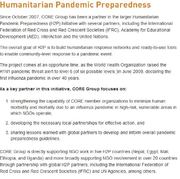
The overall goal of H2P is to build humanitarian response networks and ready-to-use tools to enable community-level response to a pandemic event.
You can download useful resources from the website http://www.coregroup.org/our-technical-work/initiatives/h2p
The Minimum Standards for Age and Disability Inclusion in Humanitarian Action inform the design, implementation, monitoring and evaluation of humanitarian programmes across all sectors and phases of response, and in all emergency contexts, ensuring older people and people with disabilities are not e
...
Broken Links: Psychosocial support for people separated from family members (Training
module) and the corresponding Broken Links field guide are designed to support staff and
volunteers in a wide range of settings where they may be in contact with families who have
been separated from their loved
...
Broken links Psychosocial support for people separated from family members: a field guide
recommended
The 40-page field guide outlines possible causes of separation, discusses the psychosocial impacts of being separated, such as how we experience loss, and provides guidelines on how to support those who have been separated from family members – including delivering difficult news to loved ones, ba
...
УТРАЧЕННЫЕ СВЯЗИ Психосоциальная поддержка людей, утративших связь с членами своей семьи
recommended
Сломанные ссылки Психосоциальная поддержка людей, разлученных с членами семьи: руководство на местах. В 40-страничном руководстве описаны возможные причины разлук
...
The main aim of this assessment was to evaluate the PSS response of URCS to these VHF, against the needs of beneficiaries and communities focused on the areas of most ‘added value’ of the URCS; community engagement mobilisation and support, documenting any unintended outcomes and best practice r
...
