
Filter
18
Breadcrumb:
European Centers for Disease Control and Prevention ECDC
Language
Document type
6
4
3
2
1
1
1
Countries
2
1
Authors & Publishers
Publication Years
Category
2
Toolboxes
5
5
2
1
1
1
1
1
1
1
1
1
1
1
This document provides advice on personal protective measures on publictransport(e.g. bus, metro, train, commuter boats).
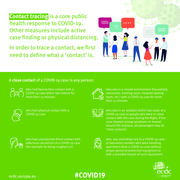
Contact tracing is a core public health response to COVID-19.Other measures include active case finding or physical distancing. In order to trace a contact, we first need to define what a ‘contact’ is.
This document aims to help EU/EEA public health authorities in the tracing and management of persons, including healthcare workers, who had contact with COVID-19 cases. It outlines the key steps of contact tracing, including contact identification, listing and follow-up, in the context of the COVID-
...
The main objective of this guidance is to provide scientific advice on public health principles and considerations for infection and prevention control of COVID-19 in migrant and refugee reception and detention centres in the European Union and European Economic Area (EU/EEA) and the United Kingdom
...
Nosocomial infections and antimicrobial resistance are two special health issues listed in Annex 1 of Commission Decision 2000/96/EC of 22 December 1999 on the communicable diseases to be progressively covered by the Community network under Decision No 2119/98/EC of the European Parliament and of th
...
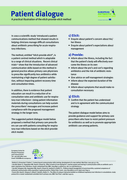
The method, entitled “elicit-provide-elicit”, is a patient centred method which is adaptable to a range of clinical situations. Recent clinical trials show that the introduction of advanced communication skills based on this method in general practice allows primary care physicians to prescribe
...
Key messages for professionals working at hospitals and other healthcare settings: managers/administrators, infectious disease specialists, infection prevention and control professionals, epidemiologists, prescribers, junior doctors and students, pharmacists, nurses, clinical microbiologists, and pr
...
Antibiotics, also known as antimicrobial drugs, are medicines that can kill or inhibit the growth of bacteria to cure infections in people, animals and sometimes plants. Antibiotics are medicines for bacterial infections (such as pneumococcal pneumonia or staphylococcal bloodstream infections); anti
...
verall strategy and objective of the European Antibiotic Awareness Day The overall objective of the European Antibiotic Awareness Day is to support national activities aimed at raising awareness concerning the proper use of antibiotics so as to maintain the efficacy of antibiotics and avoid the eme
...
Poster - Available in Different languages

póster - disponible en diferentes idiomas
affiche - disponible en différentes langues
How does antibiotic resistance spread?
Antibiotic resistance is the ability of bacteria to combat the action of one or more antibiotics.
Humans and animals do not become resistant to antibiotic treatments, but bacteria carried by humans and animals can.
The ECDC, the EFSA and the EMA have for the first time jointly explored associations between consumption of antimicrobials in humans and food-producing animals, and antimicrobial resistance in bacteria from humans and food-producing animals, using 2011 and 2012 data currently available from their re
...

This guidance document is based on research of social media activity related to antibiotic use at EU level, as well as on a survey of the social media activities of EAAD partner organisations, mostly EU umbrella organisations of patients and health professionals. The research showed that there is al
...
Este documento de orientación se basa en la investigación de la actividad de los medios sociales relacionados con el uso de antibióticos a nivel de la UE, así como en una encuesta sobre las actividades de los medios sociales de las organizaciones asociadas a la EAAD, en su mayoría organizacione
...
Ce document d'orientation est basé sur une recherche sur les activités des médias sociaux liées à l'utilisation des antibiotiques au niveau de l'UE, ainsi que sur une enquête sur les activités des médias sociaux des organisations partenaires de l'EAAD, principalement des organisations de pat
...
The toolkit offers advice on how national public health authorities could engage with primary care prescribers so as to promote appropriate and responsible use of antibiotics. The toolkit contains template materials and some suggested key messages for health professionals, idea
...
