
Filter
24
Breadcrumb:
Center for Disease Control and Prevention CDC
Language
Document type
8
4
4
2
2
2
1
1
Countries
10
1
1
Authors & Publishers
Publication Years
Category
8
1
1
Toolboxes
4
3
2
2
2
1
1
1
1
1
1
1
1
1
1
1
Use these resources to engage communities, increase cultural competence, and promote type 2 diabetes prevention and diabetes management.
For over 23 years, CDC has collaborated in Malawi with local and international partners to strengthen health systems. The office works to prevent, detect and respond to diseases. Efforts include building healthcare workforce capacity, strengthening laboratory systems, and increasing the capacity of
...

Rabies is a fatal but preventable viral disease. It can spread to people and pets if they are bitten or scratched by a rabid animal. In the United States, rabies is mostly found in wild animals like bats, raccoons, skunks, and foxes. However, in many other countries dogs still carry rabies, and most
...
96 million American adults - more than 1 - 3 - have prediabetes
If you’re interested in preventing type 2 diabetes, this guide can help you get started. Congratulations on taking the first step! By reading this, you’re already on your way. Prediabetes puts you on the road to possibly getting type 2 diabetes. Find out now, in less than 1 minute, if you may ha
...
If your result shows you’re at high risk for type 2 diabetes, talk to your doctor about getting a simple blood sugar test to confirm it. Then, if you’re diagnosed with prediabetes, consider joining a lifestyle change program offered by the National Diabetes Prevention Program (National DPP). Thi
...
Scabies is an infestation of the skin by the human itch mite (Sarcoptes scabiei var. hominis). The microscopic scabies mite burrows into the upper layer of the skin where it lives and lays its eggs. The most common symptoms of scabies are intense itching and a pimple-like skin rash. The scabies mite
...

Each year, rabies causes approximately 59,000 deaths worldwide. Despite evidence that control of dog rabies through animal vaccination programs and elimination of stray dogs can reduce the incidence of human rabies, dog rabies remains common in many countries and exposure to rabid dogs is still the
...
The term leishmaniasis encompasses multiple clinical syndromes, including the cutaneous, mucosal, and visceral forms, which result from infection of macrophages in the dermis, in the naso-orpharyngeal mucosa, and throughout the reticuloendothelial system, respectively. The infection can range from a
...
This document is intended for use by state and local health departments and healthcare facilities and serves as general guidance for the initial response for the containment of novel or targeted multidrug-resistant organisms (MDROs) or resistance mechanisms. It is not intended to describe all the ac
...
The trematodes Fasciola hepatica (also known as the common liver fluke or the sheep liver fluke) and Fasciola gigantica are large liver flukes (F. hepatica: up to 30 mm by 15 mm; F. gigantica: up to 75 mm by 15 mm), which are primarily found in domestic and wild ruminants (their main definitive host
...
Onchocerciasis, or river blindness, is a neglected tropical disease (NTD) caused by the parasitic worm Onchocerca volvulus. It is transmitted through repeated bites by blackflies of the genus Simulium. The disease is called river blindness because the blackfly that transmits the infection lives and
...
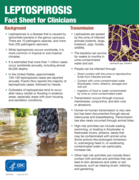
• Leptospirosis is a disease that is caused by
spirochete bacteria in the genus Leptospira.
There are 10 pathogenic species, and more
than 250 pathogenic serovars.
• While leptospirosis occurs worldwide, it is
more common in tropical or sub-tropical
climates.

When a person is infested with scabies mites the first time, symptoms typically take 4-8 weeks to develop after being infested. However, an infested person can transmit scabies, even if they do not have symptoms. Scabies usually is passed by direct, prolonged skin-to-skin contact with an infested pe
...
Leishmaniasis is a vector-borne disease that is transmitted by sandflies and caused by obligate intracellular protozoa of the genus Leishmania. Human infection is caused by about 21 of 30 species that infect mammals. These include the L. donovani complex with 3 species (L. donovani, L. infantum, and
...
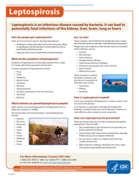
Leptospirosis is an infectious disease caused by bacteria. It can lead to potentially fatal infections of the kidney, liver, brain, lung or heart.
There is no safe level of secondhand smoke exposure
Secondhand smoke can travel within multiunit housing and common areas through doorways, cracks in walls, electrical lines, ventilation systems and plumbing.
Opening windows and using fans does not completely remove secondhand smoke.
Heating, air
...
Secondhand smoke can infiltrate into other units through hallways and stairwells. Don’t be shy when it comes to your health. Talk to your building manager about making your apartment smokefree.

The Alere Filariaisis Test Strip (FTS) is a diagnostic test used to detect filarial antigens for lymphatic filariasis. This training video was developed by ENVISION in collaboration with the US Centers for Disease Control and Prevention, with funding provided by the US Agency for International Deve
...
Secondhand smoke and the harmful chemicals in it are known causes of Sudden Infant Death Syndrome RESPIRATORY INFECTIONS, ear infections.and asthma attacks in infants and children. They are also known causes of HEART DISEASE,stroke, and lung cancer in adult nonsmokers.
