Filter
56
Featured
3
9
Language
Document type
31
13
8
2
1
1
Countries
2
2
1
1
Authors & Publishers
Publication Years
Category
7
1
1
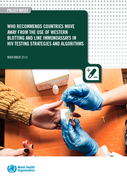
WHO recommends replacing western blotting and line immunoassays with simpler tests in HIV testing services. These simpler tests include rapid diagnostic tests (RDTs) that can be used at the point-of-care, and enzyme immunoassays (EIAs).
These tests get results to the client faster, produce accura
...
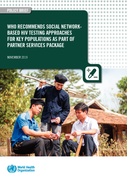
Social network-based HIV testing is an approach for engaging sexual and drug injecting partners and social contacts of key population members with HIV and of those who are HIV-negative and at ongoing risk in voluntary HTS.
By addressing people’s confidentiality concerns and broadening the reach
...
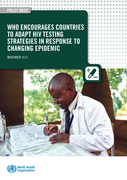
Policy brief. HIV testing services (HTS) and anti-retroviral therapy (ART) have been scaled up substantially. It is estimated that, globally, nearly 80% of people with HIV now know their status. With the offer of immediate ART initiation and improved treatment options, access to and uptake of treatm
...
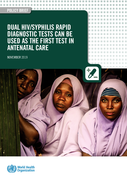
Policy Brief.
WHO recommends that pregnant women receive testing for HIV, syphilis and hepatitis B (HBSAg) at least once during pregnancy, preferably in the first trimester.
Dual HIV/syphilis rapid diagnostic tests (RDTs) can be used as the first test for pregnant women as part of antenatal care (
...
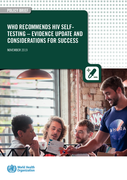
Policy brief.
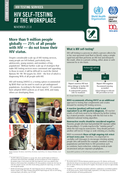
HIV self-testing (HIVST) is a convenient and confidential option for HIV testing. In 2016 WHO recommended HIVST as a safe, accurate and effective way to reach people who may not test otherwise, including people from key populations, men and young people. Lay users can perform HIVST r
...
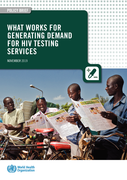
Policy brief.
Globally, one in five people with HIV are unaware of their status, despite considerable scale up of HIV testing, treatment and prevention services. Many of those unreached by HIV testing services (HTS) are from key populations, partners of people with HIV and, in Eastern and southern
...
UNAIDS / 2019 Guidance
Eaton JW et al. Journal of the International AIDS Society 2019, 22(S1):e25237 http://onlinelibrary.wiley.com/doi/10.1002/jia2.25237/full | https://doi.org/10.1002/jia2.25237
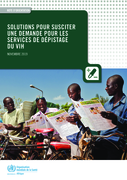
Dans le monde, une personne vivant avec le VIH sur cinq ne connaît pas son statut sérologique, malgré un développement considérable des services de dépistage, de traitement et de prévention du VIH. Nombre de ces personnes restées hors d’atteinte des services de dépistage du VIH (SDV) prov
...
Intensificar o reforço das abordagens de monitorização do tratamento através dos testes da carga viral, assim como o diagnóstico pediátrico precoce, será fundamental para garantir cuidados e tratamentos de boa qualidade e o êxito dos programas. Considerar uma boa rede de diagnósticos, tipos
...
L’expansion de la mise en œuvre des approches de suivi du traitement par la réalisation de tests de mesure de la charge virale et de tests de diagnostic chez le nourrisson sera indispensable pour garantir la qualité des soins et des traitements ainsi que le succès des programmes. Le fait de ch
...
July 2018
This fourth edition of the Unitaid/WHO market and technology landscape: HIV rapid diagnostic tests for self-testing report summarizes the current HIV testing gap; the challenges facing efforts to scale up; and the potential role HIV self-testing (HIVST) could play to achieve the United
...
Global AIDS Update 2018
Closing Gaps
Breaking Barriers
Righting injustices
HIV testing services
Policy Brief
November 2018
WHO/CDS/HIV/18.48
Supplément
Décembre 2016
Services de dépistage du VIH
October 2018
HIV testing services

ДОПОЛНЕНИЕ
СЛУГИ ТЕСТИРОВАНИЯ НА ВИЧ
ДЕКАБРЬ 2016 г.